There has always been more to the Brahmaputra River, called the Yarlung Tsangpo in Tibet, than a mere body of water for Northeast India. It is a lifeline, it is a cultural icon and the economic artery of Assam and Arunachal Pradesh. Now, by late 2025, an immense shadow hangs over this ancient river.
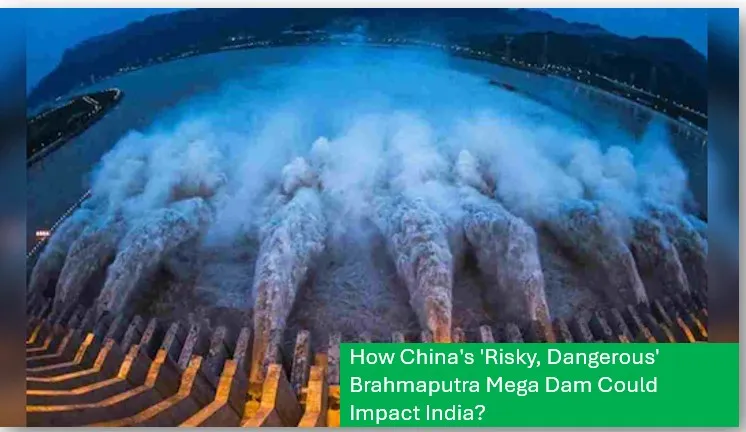
China’s official launch of the Medog Hydro Project — a mega-dam project to be set up on a scale three times more gigantic than the Three Gorges Dam — has effectively turned into an out-and-out national security crisis for India what previously was a resource-sharing problem.
The Great Bend: A Tectonic Timebomb
The so-called Great Bend, where the river makes a sharp U-turn near the Indian border before it drops by thousands of meters into the plains, is quite literally head and shoulders above everything that has gone before. Even as Beijing pitches the 60-gigawatt project as a “green energy” victory critical to its goal of carbon neutrality by 2060, on the ground it is proving terrifying.
The Himalayas are geologically “young,” floating on a very active tectonic fault line. Constructing such a “water bomb” in a region of huge earthquakes—such as the catastrophic 8.6-magnitude Assam-Tibet quake of 1950—is taking an incredible risk, verging on the biblical. If a ‘dam breach like’ seismic event did occur, millions of gallons of water would sweep through areas downstream in Arunachal Pradesh and Assam … leaving hardly any time for people to evacuate.
Hydro-Hegemony: Weaponizing the Flow
The problem for India is not simply that this is a failure of biblical proportions, but that it gives China effective control over the tap on a day-to-day basis. Government studies indicate that the dam could cut the Brahmaputra’s flow as much as 85 percent during the dry season. For the farmers of the Brahmaputra valley, dependent on this water for irrigation and fisheries, it is a death sentence for their livelihoods.
And beyond scarcity, there’s the risk of “tactical release.” At a time when the border tension is high, such sudden release of huge amount of water can emerge as a non-kinetic weapon to cause artificial flash floods in India which will bring massive destruction downstream,” sources had said. This “hydro-leverage” has provided Beijing with a strategic chokehold over India’s Northeast, one that traditional border patrolling will not be able to counter.
What Works: Silt, Soil and Species
Rivers are more than water; they are conveyors of life-sustaining silt. With it, the Brahmaputra brings some of the heaviest silt loads in the world, enriching Assam’s fertile flood plains year by year. By impounding this silt behind gargantuan concrete walls, the Medog dam is in effect going to “starve” the soil further downstream.
Those environmental ripples will reach to the Kaziranga National Park, home to the world’s largest population of one-horned rhinoceroses. The full ecosystem of the park relies on this seasonal flooding to nourish its grasslands and waterways. Upset this flow, and the habitat could fall apart, ailing more than just the rhinos but hundreds of migratory bird species and the endangered Gangetic dolphin.
The “Dam for a Dam” Strategy
In retaliation, New Delhi has found itself on the back foot – forced into a counter-press position which finally took shape last year when India announced an 11-gigawatt “counter-dam” of its own just over the line in Arunachal Pradesh’s Upper Siang district. The logic is simple but desperate: India requires its own huge reservoir so it has the “buffer” to contend with any sudden discharges or diversions from the Chinese side.
But this “dam-building race” is a zero-sum game. Local indigenous communities like the Adi tribe are caught inbetween fighting against submergence of their ancestral land for a project they never demanded.
Without a binding water-sharing accord with China (as there is with Pakistan, through the Indus Waters Treaty), there are no legal mechanisms to prevent a conflict, or what some fear would actually be a “water war.” In the absence of transparency and a legal accord, the Brahmaputra — once recognized locally as a life-giver — could become an unending conflict spot.

A versatile writer mainly works on trending news, daily updates from politics, business, crime, current affairs and entertainment.