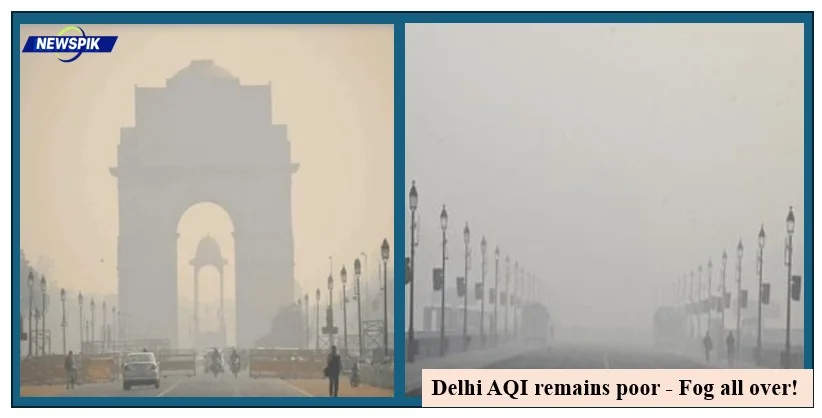

Delhi began the day with a further dip into a blanket of fog, with air quality persisting within the poor category. The low visibility, coupled with the cold and air pollution, made it quite a challenge for people to get around, thereby emphasizing the annual winter crisis that the city faces.
The images from early morning in central, northern, and eastern parts of Delhi revealed thick fog rolling in over roads, parks, and residential areas. The visibility factor also significantly deteriorated in various parts, which resulted in congestion on roads and also affected train services. Although air transportation functions were fairly smooth, the situation was closely monitored due to variations in the density of the fog.
As per sources, Delhi’s Air Quality Index (AQI) remained in the poor category, with hotspots touching the very poor categories. Most pollutants, including PM2.5 & PM10, were measured significantly high above the safe level, proving hazardous to health, particularly in children, senior citizens, & people suffering from lung problems.
Why winter worsens Delhi’s air?
According to experts, winter meteorological conditions are one of the principal factors that result in the trapping of pollution close to the ground level. The slower speed of the wind, high levels of moisture, and reduced temperature create conditions where vehicle emissions, industrial emissions, emissions from construction activities, and biomass burning are not dispersed but get trapped.
Fog further aggravates this problem. Though fog itself is a weather phenomenon because of the condensation of water vapors, it often mixes with pollutants created in cities, causing smog. This adverse mix affects visibility and breathing.
Recently, there has been a lack of wind, which has resulted in high humidity, thereby preventing the dilution of pollutants. This has, in turn, led to poor air conditions. Temperature inversion, a major cause of air pollution, has also been experienced, especially during cool nights.
Impact on daily life
The foggy and polluted environment caused disruptions in the usual activities of the city. Commuters said traffic flow was slower, and traffic jam cases were seen on major roads due to the reduced visibility. In the early morning hours, pedestrians and cyclists had issues with movement, and delivery and transport services took longer.
Health experts have warned that inhalation of polluted air can cause coughing, irritation of the throat, irritation in the eyes, as well as exacerbation of asthma and bronchitis. Many hospitals have seen a rise in admissions for patients suffering from respiratory disorders, a situation commonly witnessed in winter.
Schools were kept open, but doctors asked parents to restrict their children’s outdoor outings, especially during the early morning and evening hours when the levels of pollution are known to surge.
Measures in place
Various measures have been implemented by the authorities in an effort to control pollution, in relation to already formulated strategies for air quality management. These include limits on construction work, enhanced monitoring of vehicle emissions, and advice against burning solid fuel for heating.
Water spray on main roads, as well as the deployment of anti-smog guns in pollution-prone zones, has also increased to tame dust pollution. People have also been encouraged to use public transport or car pooling, as well as avoiding unnecessary travel when pollution peaks.
Experts on environment issues, however, feel that short-term strategies are not adequate. They require long-term efforts on clean transport, improved waste management, a shift to renewable sources of energy, and coordination on a regional level with other countries to address stubble-burning and emissions from industries.
Delhi implements 50% mandatory work from home amid air pollution crisis
What lies ahead?
If weather forecasts are to be believed, it can be expected that the foggy conditions are likely to continue for a few days, and there will be no relief in air quality unless the wind speed picks up or there is any rainfall. Until then, the people of Delhi are bound to suffer from air pollution.
The problem, with the onset of winter, is one that is no longer only a matter of coping with the situation but also one that must be prevented from being accepted as a fact of life.

I am a versatile content writer from the MP region, covering politics, business, crime, current affairs, entertainment, video games, and sports with clear insights, engaging analysis, and timely, reader-focused updates.