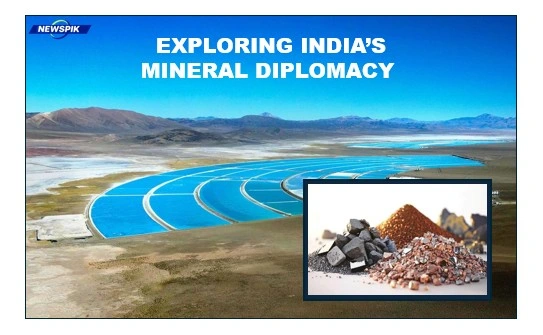

Mineral diplomacy is an area that is now one of the main and imperative elements on the Indian foreign policy agenda in the 21st century. This can be explained, to some extent, by the fact that today, the more so in recent years, India is one of the worlds fastest developing large economies, and hence, there is a great rise in the demand for mineral commodities, especially the strategic mineral commodities, by the country. The mentioned mineral commodities have proved to be of immense significance and necessity in the development and growth of new sectors in the Indian economy.
Reason that underlies the Mineral Diplomacy
It relies on various major imports of critical minerals. For instance, their major sources of lithium, cobalt, nickel, rare earth elements, and various forms of copper are basically imports. Such critical minerals are needed for various forms of renewable energy technologies, energy storage, various electronics, and various military applications. The global value chains of such critical minerals are highly centralized, and in most cases, a particular country controls such chains, with China being dominant.
Therefore, the aim of mineral diplomacy is to enhance the security of natural resources to the Indian government. This does not only include ensuring the minerals are secured. It also includes the creation of a global partnership. This is because of the idea of a global perspective on minerals, which meets the needs of all countries.
Main Tools and Methods
Bilateral and multilateral cooperation is one of the primary instruments of India’s mineral diplomacy. India has entered into memoranda of understanding and strategic partnerships with countries rich in minerals such as Australia, Argentina, Chile, Bolivia, South Africa, Namibia, and Mozambique. For example, Australia is an important partner for India with which it imports Lithium and strategic minerals, while the Latin American countries are at the forefront of India’s Lithium strategy.
Institutionally, an appropriate body in India has been established in the form of Khanij Bidesh India Limited (KABIL), which is a joint venture of three public sector entities, with the main aim of acquiring mineral resources abroad.
KABIL plans on focusing on the extraction of lithium, cobalt, and other strategic materials either directly or indirectly through equity joint ventures, long term offtake agreements, or joint exploration ventures.
In fact, it is also interesting in a multilateral fashion, in the sense that involvement in various groupings like the Quad has enabled engagement in critical supply chains, technology, and standards. Likewise, the engagement in the International Energy Agency and the Minerals Security Partnership illustrates the desire to make and not merely implement global rules.
India and New Zealand announce Landmark Free Trade Agreement (FTA)
Africa and Latin America: Strategic Frontiers
Africa is viewed as an important element in the mineral diplomacy policies of India because it has reputed deposits of cobalt, PGMs, phosphates, and rare earths. The method adapted by India in Africa focuses on development partnership because it entails mineral resources accessibility as well as the development associated with the human resources facet. This is as opposed to the modes associated with the mining method because it is associated with resentment creation.
The “Lithium Triangle,” which comprises Argentina, Bolivia, and Chile, is also a crucial area in Latin America for India. Notably, this has led to high-level exchanges, joint working parties, and investment by the Indian government, adding to India’s diplomatic outreach in the hope of securing access to crucial lithium sources for India’s EV ecosystem.
Challenges and Constraints
Despite its growing significance in Indian foreign policies, various challenges are currently faced by India’s mineral diplomacy. For example, the competition from China is highly intense because China has developed significant economic and infrastructural bases in mineral-rich nations. Indian companies would find it challenging to compete with the favorable base that the Chinese enjoy.
On the domestic front, there are factors too. The risk appetite, mining technology, and exploration budget may be lacking in Indian companies compared with global rivals. This might discourage Indian ventures abroad.
The other challenge facing the mining industry in general, and IOU in particular, relates to environmental, social, and governance factors, commonly referred to as ESG factors. The mining activity has gained increased focus globally, and IOU has to make sure that its international mining activity does not go against environmental and ethical norms so as not to threaten IOU’s reputation.
The Way Forward
What India needs is a holistically formulated approach in the future for a stronger mineral diplomacy approach in the country. The approach should address foreign policy integration and industrial policy integration in the country in addition to public private partnerships. There has to be resources economics expertise in diplomatic missions in the country. A more critical and equally important factor would be domestic reform entailing an increased recycling pace, urban mining, and substitution technology in order to minimize reliance on outside sources. Other ways to strengthen resilience include strategic stockpiles and collaborative international research efforts.
Dubai: Why the World’s Wealth — Including Indians — Is Choosing
Conclusion
The relevance of mineral diplomacy in India is given as it has implications in current developments in international power structure shifts. This is considering that current developments in international power politics indicate that economic opportunities have become dependent on a certain degree of mineral resource security. The geopolitics of earth sciences and technological developments might be managed and controlled, but international priorities and strategies of those states wanting to advance and develop focus on an economic agenda of resource security and assurance of these aspirations within their regional neighborhood.

I am a versatile content writer from the MP region, covering politics, business, crime, current affairs, entertainment, video games, and sports with clear insights, engaging analysis, and timely, reader-focused updates.









