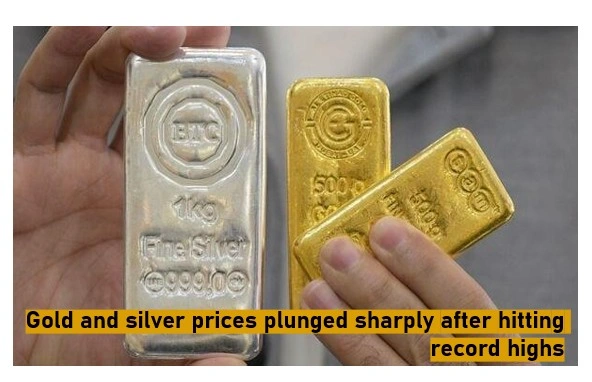

Precious metals experienced one of their largest swings in recent memory: On Friday, January 30, 2026, Gold’s price fell about 13% while Silver’s price fell almost 37% over the course of a single trading day. The coins both lost record-breaking amounts. Earlier in the week, Gold and Silver prices were at all-time highs due to a large amount of both speculative buying and a flight-to-safety.
When President Trump announced that he would nominate Kevin Warsh to the position of Chairman of the U.S. Federal Reserve System, the reactions in the gold and silver markets caused dramatic decreases in precious metal prices. Many economists are describing Warsh as being hawkish and are, therefore, raising their expectations of the amount of cuts to the Federal funds rate, which have previously been viewed as more aggressive. This resulted in an increase in the value of the dollar versus other currencies as well, thus providing further downward pressure on the price of the dollar-denominated assets of Gold and Silver.
The strengthening U.S. dollar resulted in lower demand for gold and silver, as these metals do not pay any interest or dividends. As the dollar’s value increases relative to other currencies, the price of gold and silver measured in other currencies rises to a degree that makes gold and silver relatively expensive for holders of non-dollar currencies. This caused a large number of long positions established by investors over the past year to be liquidated for profits.
Volatile and Record Size Intraday Moves On major exchanges:
Over the first round of trading, gold futures fell sharply from their previously high prices. From the prior price point, they dropped by more than 20% (about 3% in total), for at least part of the trading day, close to $8,000/ oz (approximately $2.5 billion was lost in commodity futures).
Gold and silver futures declined more than 20% and 30%, respectively. Because of this, the other futures products in commodities suffered as well from reduced buying demand from investors, who were liquidating for profits and re-allocating their capital into lower-risk investments.
An additional case in point regarding gold, and the price instability that surrounds it, is the silver market, as it also had a significant decrease in price relative to gold. Thus, there is an ongoing correlation between the price of gold and the price of silver, with price fluctuations lasting at least 30 minutes following the initial sell down.
Commodity trading continues to be influenced by price fluctuations, as the US Stock Market’s every move is instantaneously transmitted throughout the world through electronic trades. The primary confusion regarding trading is that the fundamental or technical implosion of even the most stable environments, or the rapidly changing (and totally fluctuating) nature of those transactions, has created a great deal of uncertainty about the timing of when the damage caused to an investor’s portfolio occurs, which will happen before an individual invests in either or both non-dividend securities.
In general, the momentum exists for several factors to support an upward move back above $5000 for the gold market. If the gold market returns to the all-time highs of January 2021, other pricing methodologies could generate new all-times highs before 2021, in terms of either fundamental prices or technical prices.
Gold costs Rs 24,600 more in two days. Can it hit record highs?
Conclusion:
Will Gold Price Stabilize On A Lower Price Point Than Gold’s All-Time High?
If historical highs in gold have been reached between the base and time frame of October 28, 2021, to December 31, 2023, then it is possible that precious metals will provide a price-stable price region of between $3,000.00 and $6,000.00/oz before the time frame of 12/12/2021 to 12/31/2023; thus forming the basis for future gold price increases and establishing a price anchor for substantial price increases going forward.
Are These Recent Declines in Precious Metals Representative of Temporary Corrections in the Market, or Are They Indicative of Deeper Problems in the Markets?
Market analysts are hesitant to make any predictions at this point as to whether Friday’s market decline was a “temporary” pullback in prices as opposed to an indication of a protracted decline. Many analysts are of the opinion that the long-term structural demand factors for silver and gold (i.e., industrial and central bank uses) will continue to have a positive impact on these metals’ long-term prices regardless of short-term price declines. Others perceive that the continuing volatility in both gold and silver will persist due to continued erosion of confidence in the central banks’ monetary policy.
Putting ₹1 Lakh into silver in 2005 would be worth about ₹16.6 Lakh in 2026
Investor Impact
The recent price movement serves as a significant warning for all investors regarding the potential risks tied to the commodity trading market; when conducting highly leveraged trades, these price swings generally happen more quickly than would be expected. Long-Term Investors who made the correct buy on their investment in these types of markets may now be ahead relative to the overall market however recent fluctuations in the price of various products demonstrate just how quickly the outcome of the speculative market can change due to lack of liquidity on exchange.

A versatile writer mainly works on trending news, daily updates from politics, business, crime, current affairs and entertainment.