
There will be more job subsidies, Rs 500 crore to fix up estates, and plans for new cities, but industry leaders are most worried about the cost of land, power outages, and Inspector Raj.
Haryana’s new industrial policy calls for more job subsidies, improved hubs, and the building of new townships. Industry groups say these steps will help, but they don’t solve their long-standing problems with land costs, power outages, and inspection raj.
Next month, the Haryana Industrial Policy 2026 is set to go into effect. Its goals are to bring in Rs 1 lakh crore in investments and create 5 lakh new jobs, government officials told ThePrint Thursday.
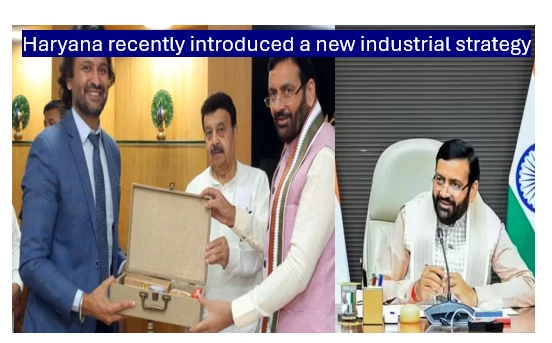
Chief Minister Nayab Singh Saini and Minister of Industries and Commerce Rao Narbir Singh
They both have met with business leaders several times to talk about the policy.
More than 15 business leaders from the pharmaceutical, solar, and data center industries met at Haryana Bhawan in Delhi on Wednesday. Textile exporters from Panipat, Sonipat, Faridabad, and Hisar met separately. These are some of the country’s top exporting areas, but they are under a lot of stress right now.
During the meeting, Saini admitted that the sector’s problems are unique and told officials to write a different report about them.
Officials say that the program calls for businesses to get twice as much money to help hire people, from Rs 48,000 to Rs 1 lakh per year.
A Rs 500 crore Saksham Fund was also suggested in the state budget for 2026–27 to help update and improve old industrial areas in Sonipat, Hisar, Ambala, Yamunanagar, Sirsa, Fatehabad, Nilokheri, Bahadurgarh, Barwala, and Panipat.
Also, new Industrial Model Townships (IMTs) will be built. In Ambala and Naraingarh, land is being bought, and plans for IMTs have been asked for in Tosham, Jind, Rewari, Faridabad, and Rai.
Ashok Chhabra, who works as the chief minister’s media assistant, said that the new policy would include honest and sensible ideas from business.
Read also: Haryana unveils rooftop solar drive to cut power bills
A land, power, and an inspector
Rakesh Chhabra, who is in charge of FISME, the Rai Industry Association, and the Sonipat chapter of the Haryana Chamber of Commerce and Industry, said that the talks keep bringing up the same problems that haven’t been fixed. The one that stays the same is land cost.
The second long-term issue is the power source. “Haryana doesn’t have a lack of power in general.” But because of bad infrastructure that breaks down often, the industry doesn’t get a steady flow of power, which is needed for growth, Chhabra said.
He said that the safety and health branch of the Labour Department can now visit factories without getting permission from the main office first. This replaces a rule that had been in place for decades to stop random searches.
Wage time and the motivation gap
Another problem is a strange thing about the way incentives are set up.
The state government gives Rs 3,500 a month to each worker for seven years to businesses in zones B, C, and D. However, Chhabra said that units in zone A, such as those in Rai, are not eligible.
In Haryana, areas are put into A, B, C, and D zones based on how much industrialisation they have.
Gurugram and Faridabad, which are very developed, are in group A and get the fewest rewards. In group D are underdeveloped areas like Nuh and Sirsa. Businesses in these areas get the most help, such as grants and lower taxes.
Chhabra said that this cap on incentives doesn’t make much sense, especially since the minimum wage has been raised.
The government of Haryana raised the minimum wage for workers in industries by 30 to 35 percent as of April 1, 2018. At the moment, pay are set at Rs 15,220 per month for workers with no skills, Rs 16,780 for workers with some skills, Rs 18,500 for workers with skills, and Rs 19,425 for workers with high skills.
Chhabra said that the timing of this rise was especially bad for businesses. The war in West Asia has also hurt exports, and the prices of raw materials that come from oil, like plastics, nylon, sulphur, and urea, have gone up sharply.
It was planned that Haryana would give Rs 1,950.9 crore to business and industry in the 2026–27 budget, up from Rs 1,327.7 crore in the updated figures for 2025–26. This is a 47 percent increase. A big part of this spending goes to giving the business tax breaks. “Only the government’s industrial policy tells us how they plan to give these incentives,” he said.
Read also: Global Supply Chains Under Siege: War Sends Shockwaves Through Logistics Industry
What’s wrong with 80%
Rajeev K. Chawla, President of the Integrated Association of Micro, Small, and Medium Enterprises (IAMSME), talked about what he called an unfairness that has been going on for decades and hasn’t been fixed by policy: the fact that industrial units in places that don’t meet government standards aren’t eligible for government rewards.

A versatile writer mainly works on trending news, daily updates from politics, business, crime, current affairs and entertainment.