In the story of Viksit Bharat 2047, it is this area of the Aravalli that gets called “Green Wall” – shielding India’s economic heartland from environmental ruin. But by the end of 2025, a novel legal definition has transformed this time-worn mountain range into a battleground.
The Supreme Court’s acceptance of the “100-metre rule”—landforms must be 100 metres taller than their local relief to legally qualify as an Aravalli Hill— has provoked national discussion. The government sees this as a step towards administrative clarity, but critics insist it’s a “death warrant” that amounts to thumbing the nose at India’s sustainable development goals.
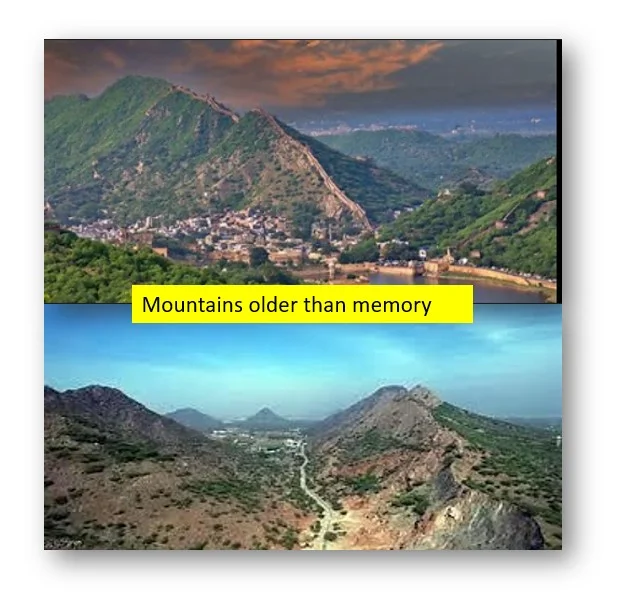
The “100-Metre” Paradox
For years, the Aravallis had no single definition. Rajasthan, Haryana and Delhi followed three different criteria leading to illegal mining and urban encroachment. To fix this, the Supreme Court agreed with the Union Environment Ministry’s suggestion:
The rule: A landform is an “Aravalli Hill” only if it stands 100m or more above the surrounding earth.
The Range Two or more such hills separated by less than 500 metres are grouped into a “range” of Aravalli.
The Unseen Majority: Based on an assessment done by Forest Survey of India (FSI), only 1,048 hills or approximately 8.7 per cent, out of the total 12,081 hills mapped across the range fulfils this criteria to qualify as a natural monument.
Why it is a Blow to “Viksit Bharat”?
TheKisanKarya is built around the vision of a developed India (Viksit Bharat) which has three pillars on which the Aravallis serve directly as:– Water Security, Climate Resilience, Public Health. By eliminating 90% of the range from “Aravalli” status, the new definition risks pulling apart these buttresses.
The Threat to Water Security
Viksit Bharat is also nothing without water. The Aravallis are the prime source of groundwater recharge for the National Capital Region (NCR) and Rajasthan.
The Risk: Most groundwater recharge occurs not over the flats where the peaks are, but through the low-lying ridges, fractures and foot hills – precisely one of the areas now excluded by the 100-metre rule. But if these “hillocks” are opened up for mining or real estate, the water table in neighbouring cities like Gurugram and Faridabad is likely to fall beyond the point of no return.
Desertification and the “Dust Bowl” Effect
One central initiative is the Aravalli Green Wall Project, designed to reclaim 26 million hectares of degraded land by 2030.
The Risk: The Aravallis are a buffer against the eastward expansion of the Thar Desert. Small breaks in the range, where ”non-Aravalli” hillocks have been removed, could function as wind tunnels.” This would channel desert sand and dust to the Indo-Gangetic plains, escalating dust storms and degrading fertile agricultural land crucial for food security.
Public Health and “Green Lungs”
You need to keep your population healthy for a nation to be developed.
The Risk: Declassifying lower hills lift the protection on them from developing. Concrete heat islands instead of scrub forests will only exacerbate the already dangerous air quality crisis in Delhi-NCR and most likely increase healthcare expenses and drop economic productivity.
The Government’s Counter-Narrative
The environment minister, Bhupender Yadav, has emphatically denied that this amounts to a dilution of protection.
“The Inviolate” shield: The government insists that all tiger reserves, national parks and eco-sensitive zones are out of bounds for mining irrespective of their description as low density or medium to high density.
Administrative Clearity: Officers claim that a height-based definition is objective and can be assessed on Survey of India toposheets, thus limiting the scope for local mining mafias to exploit “ambiguous” slope-based definitions.
Conclusion & Next Step
The war of words over the 100 metre rule is typical “Development vs. Conservation” schmooze. If “Viksit Bharat” is to actually be developed, it should sustainable. A purely technical concept, which impairs the ecological whole of the range may yield a short-term mineral wealth at the penalty of long-term environmental bankcrupcy.
Conservation Watch: The future Scientific Mapping of the range will be the most important document of 2026. It will decide which particular “No-Go” zones are conserved for the next generation.

A versatile writer mainly works on trending news, daily updates from politics, business, crime, current affairs and entertainment.