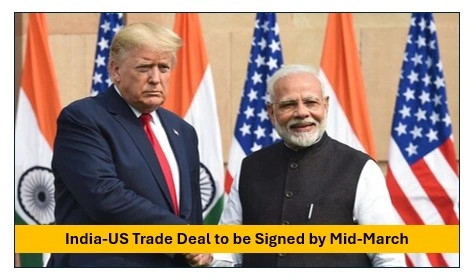

India and the United States look ready to agree on a long-awaited Trade Agreement by mid-March. This will create a significant milestone in the two countries’ Economic Partnership. The negotiations have been going on for several months and the intent of the agreement is to resolve major issues concerning Access to each other’s markets in order to strengthen the two countries’ Strategic Trade Cooperation.
Negotiators from both sides have made significant progress related to all outstanding issues during the period of negotiations. As such, both sides have resolved most of the major issues, including tariffs, besides the removal of all Regulatory Barriers to enable them to reach a Trade Agreement with one another.
Key areas covered in the agreement
The expected Trade Agreement is seen as a true step in the right direction based upon shared Political Will. The shared political will exists as a result of the long-standing history of Trade Relations that have been marked by consistent Friction during the past few years with respect to Tariffs, Data Policies, and Import Restrictions.
In terms of what the Trade Agreement may cover, it is expected to include a wide-range of sectors including, but not limited to: Market Access for Agricultural Products; Market Access for Medical Devices; Market Access for Digital Products; Market Access for Industrial Products.
India is looking to increase The amount of Market Access it has to sell its Pharmaceuticals, Textiles and IT services to the U.S., while the U.S. is looking to reduce Tariffs and eliminate Regulatory Barriers on Agricultural Exports and Manufactured Goods that the U.S. is currently exporting to India.
The final framework will most likely include provisions for the protection of intellectual property; harmonization of standards; and areas focused on making supply chains more resilient.
The Bilateral Trade & Investment Boost
The US is one of India’s fastest-growing trading partners, and India’s trade with the US over the last 10 years has been consistently increasing. Officials of both countries expect that this agreement will increase the volume of bilateral trade and encourage cross-border investments.
Business leaders across all industries have made positive comments regarding the potential of a trade agreement being finalized. They believe that it will be a sign for businesses interested in expanding and diversifying their supply chains during these uncertain times.
Strategic and geopolitical implications
Beyond the economic implications of this trade agreement, there will be broader strategic implications associated with a more robust trading relationship between India and the US, including an already-existing India-US strategic alliance in Asia/Pacific. Maintaining strong cooperative relationships between India and the US for trade purposes will help to create a new level of cooperation to support existing partnerships in the areas of defence, technology and clean energy.
Experts indicate that this agreement will help both countries to reduce their reliance on single-country supply chains and stimulate several new opportunities for creating trustworthy supply chains through innovative resources.
Remaining Steps Before Final Sign-Off
Although negotiations are mostly finished, the agreement still has to go through formal approvals and legal vetting before it can be officially signed. Sources say that both parties’ senior political leadership is keeping close watch on the agreement in order to make sure that it is signed by the mid-March date.
When signed, the agreement will likely go through domestic procedure clearances depending on how it is ultimately structured and scoped prior to being finalized.
Outlook
If the agreement is completed by the anticipated date, then this agreement between India and the U.S. would be one of the most significant developments of U.S.-India economic relations in recent years. This agreement follows the growing convergence of U.S. and India on their strategic and economic priorities and is likely to establish the framework for greater and more expansive trade engagement between them in the future.

I am a versatile content writer from the MP region, covering politics, business, crime, current affairs, entertainment, video games, and sports with clear insights, engaging analysis, and timely, reader-focused updates.