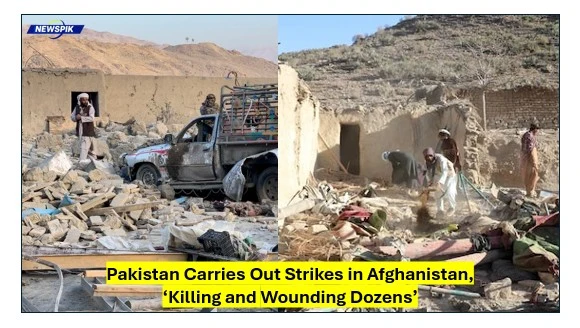

It was not the normal hush of winter wind that fractured the night sky in the rugged borderlands of eastern Afghanistan one day last week. Instead it was ripped open by the scream of jet engines and the crashing thunder of explosions. In what the Pakistani government characterized as “intelligence-based, selective operations,” airstrikes struck several locations in the provinces of Paktika and Nangarhar, leaving behind smoke, rubble and a grim tally of human suffering.
And while the official line from Islamabad is about precision and national security, the reality on the ground in Barmal and Behsud districts is of domestic lives upended. Initial accounts from Afghan officials and local witnesses indicate that the “precise” strikes struck more than militant hide-outs when they targeted civilian communities.
The Collateral of Retribution
The strikes killed “dozens of people, including women and children,” said Zabihullah Mujahid, a spokesman for the Afghan government. The house of a civilian named Shahabuddin was allegedly turned into a skeleton of brick and dust in the Behsud district of Nangarhar. Rescue teams spent the predawn hours on Sunday clawing through debris. At least 23 members of a single family were feared buried under the ruins of their own home — a place that, just hours before, offered protection from the biting February cold.
“We were sleeping and then the earth shook,” said one local resident, whose voice quavered as he spoke through a messaging app. “The children are not soldiers. The elders are not militants. Why is war brought into our bedrooms?”
For residents of the Indian subcontinent in villages near the Durand Line, an invisible line that’s long served as a flash point for regional tensions, the whir of an incoming aircraft has gone from curiosity to warning sign. But in the dead of night, there is no escape. The strikes also targeted a religious school (madrasa) in the Barmal district, which locals claim was full of students, not insurgents.
A Cycle of Violence: Why Now?
The strikes were no unprovoked, at least as the Pakistani military saw it. Pakistan has been on edge for weeks after a domestic terror spike. Just days before that, a suicide bombing at a Shiite mosque in Islamabad killed 31 worshippers and there was an ambush of soldiers and civilians in the Bajaur district that left 11 soldiers and a child dead.
Pakistan has “irrefutable” evidence proving the attacks were planned by the Tehreek-e-Taliban Pakistan (TTP) with support from its affiliates who are using “sanctuaries” in Afghanistan, according to Information Minister Attaullah Tarar. “We have been reiterating our concerns that Pakistan’s enemies are operating from Afghanistan and planning/hosting terrorist activities towards Pakistan,” the tweet said, adding: “It is reiterated that such incidents must be investigated.” Wahidullah Mayar, a spokesman for the Afghan public health ministry, confirmed casualties after firing broke out at about 9.30am.
For the logic of the state is frequently that of “retributive response.” When a soldier dies in Waziristan or when a civilian is killed in Islamabad, the pressure on the Pakistani state to “do something” becomes overwhelming. But as the bombs land over the border, they frequently leave in their wake the very kind of vacuum of stability under which extremism thrives.
Also read:
- Pakistan attacks on Afghanistan
- Saudi Airstrikes in Yemen Conflict
- Loud Explosions In Venezuela After Trump Warns Of Ground Strikes
The Thin Line of Diplomacy
The two countries have been referred to as “unhappy cousins:” Their shared identity is more than simply geographic; but through culture and history, one carries an inherent mistrust for the other. The border has been the stage for occasional skirmishes and “tit-for-tat” escalations since the Taliban took power in Kabul last year.
Security experts say the targeted killings signal a major shift in Pakistani policy. For years, Islamabad relied on diplomatic pressure and border closures. Now it seems prepared to wield its air force to extend power directly into Afghan territory, prompting the Afghan ministry of defence to denounce a “reckless violation” of sovereignty.
The most powerful human cost of this diplomatic breakdown has been borne by the displaced. At provinces such as Paktika, many of those caught in the crossfire are refugees who had already escaped violence from Pakistan’s tribal areas years ago. They are a people who have only known travel and terror, hemmed in between a homeland that mistrusts them and a host country powerless to defend them.

I am a versatile content writer from the MP region, covering politics, business, crime, current affairs, entertainment, video games, and sports with clear insights, engaging analysis, and timely, reader-focused updates.