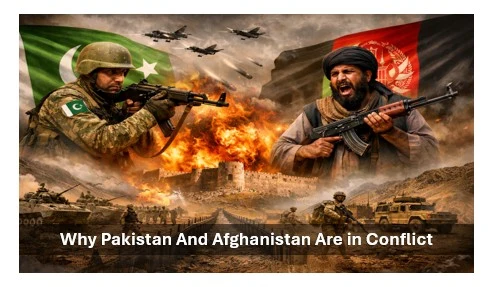

Tension escalated significantly recently between Pakistan and Afghanistan and resulted in cross-border fighting, air strikes, and political finger-pointing by both sides. Despite their long-standing historic, cultural, and economic connections, the relationship between Pakistan and Afghanistan has normally been antagonistic largely due to security issues and border issues.
The present tensions between Pakistan and Afghanistan appear to be driven by (1) militant activity; (2) border disputes; and (3) diplomatic breakdowns. Here are some of the contributing factors that explain the current status:
1. Militant groups operate near the Afghanistan-Pakistan border
The ongoing tensions are largely the result of the presence of militant groups operating near the Afghanistan-Pakistan border. Pakistan has continually accused the Afghanistan government (notably under the Taliban regime) of providing sanctuary to Tehrik-e-Taliban Pakistan (TTP) and allowing TTP to conduct operations inside Afghanistan. TTP (the Pakistani Taliban) has launched countless attacks against Pakistani military, police, and civilian targets.
Pakistan argues that there are many people who commit acts of violence within Pakistan who cross back into Afghanistan after escaping into Pakistan. Afghanistan denies that it is involved with these cross-border attacks and asserts that Pakistan has exaggerated the situation to provide it with a justification for military action.
2. Disputes Over the Durand Line Border
A dispute over the Durand Line, which is the primary source of dispute between the two countries, has existed for decades. The Durand Line is a 2,640-km (1,650-mile) line that separates Afghanistan from Pakistan.
While the Pakistani government asserts that the Durand Line represents the legitimate boundary between the two countries, the vast majority of Afghan politicians and political parties do not see it as such, arguing instead that the line was drawn during British colonial rule in an effort to fragment and dominate local ethnic Pashtuns.
Additionally, Pakistan’s attempts to erect fences along the Afghan-Pakistani borders have contributed to the rise in conflicts between these states. Pakistani authorities state that this fencing was necessary to prevent terrorist infiltration, while Afghan forces may remove sections of the fence as part of their efforts toward disrupting militant activity and avoid military confrontation with Pakistani forces stationed on the opposite side of the fence.
3. Airstrikes and Military Escalation
The third major source of tension between Afghanistan and Pakistan has been Pakistan’s use of aerial bombardment against alleged insurgent targets in Afghanistan. These bombardments often occur subsequent to significant attacks on the Pakistani side of the border.
Afghan officials have condemned these aerial bombardments, stating that they are violations of Afghanistan’s sovereignty and in some cases, claim that these strikes resulted in the loss of civilian life in Afghanistan. As a result of these deaths, Afghanistan border forces have sometimes engaged in fire exchanges with Pakistani forces stationed adjacent to the border. The potential for any one of these instances to escalate into broader military hostilities is very high.
4. Rise of Cross-Border Attacks
Recently in Pakistan, there have been more militant attacks in Khyber-Pakhtunkhwa and Balochistan. The military says that a lot of these attacks are linked to militants who are based in Afghanistan. After the fall of the Taliban’s government, Pakistan thought it would get help from the Taliban to stop the cross-border activity of anti-Pakistani militants. But nothing has changed, and in fact, Pakistan thinks that more militant activity is happening now that the Taliban is in power.
5. Diplomatic Breakdown and Political Tensions
Political relations between the governments of Pakistan and Afghanistan have weakened over the last few years. The two governments have had limited success in resolving border issues and resolving security threats related to the militant activities of their citizens.
In addition to this deterioration in relations, Pakistan has expelled many thousands of Afghan refugees citing security issues and illegal residency. Afghanistan does not agree with these decisions, calls these actions inhumane and sees the actions as politically motivated. All of this adds to the tension between the two countries.
6. Regional Security Concerns
A broader impact of the conflict exists beyond the immediate conflict between Pakistan and Afghanistan. The spilling over of instability from their border has implications for security throughout South and Central Asia, which has created a level of concern within the region and beyond about the possibility of extremist groups becoming established within the region if clashes continue to escalate.
Read more:
Summary
The conflict between Pakistan and Afghanistan stems from several historic, militant, political, and socio-economic factors, but the most pressing issues affecting their relations are terrorism across borders, the Durand Line dispute, and military retribution, all of which have pushed the two countries into an unsustainable cycle of violence. In addition, as long as the two sides do not engage in a sustained dialogue and cooperation regarding security, the probability for escalation remains high.

A versatile writer mainly works on trending news, daily updates from politics, business, crime, current affairs and entertainment.