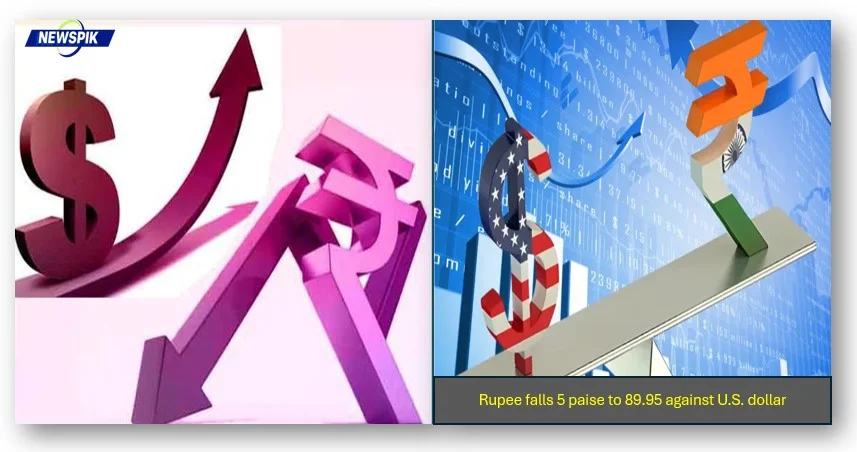

The Indian rupee opened 5 paise down at 89.95 against the U.S. dollar in early trade hours on Monday (December 29, 2025), due to foreign fund sales and a dull start in the local equity markets.
The Indian rupee opened the day with a weak start on Monday, dropping by 5 paise to the U.S. dollar price of ₹89.95, as foreign investor exits continue and the domestic market lacks strength. The rupee has been falling as the entire emerging market has come under the influence of global macroeconomic trends, making it vulnerable to fluctuations and changes in the global economy and markets.
The domestic unit opened at 89.95 against the foreign exchange interbank, down from its last close and maintaining the weak trend that has been experienced throughout the previous week’s trade. The rupee closed at 89.90 to the dollar on Friday after losing 19 paise.
Market Drivers: What’s Pressuring the Rupee?
1) Foreign Portfolio Outflows
One of the main contributors to the rupee falling is the sale of rupees by foreign portfolio investors (FPIs) in the Indian equity market on a constant basis. According to the exchange, the FPI sold stocks to the tune of ₹317.56 crores on Friday, thus adding to the total sales in the previous trading sessions. This sale of rupees impacts the demand for rupees, as foreign investors will require more dollars.
Foreign funds have been under pressure throughout 2025 due to a series of international as well as domestic reasons. These reasons include subdued growth in major economies and increased U.S. Treasury yields that make the U.S. dollar more attractive as compared to risks present in emerging markets.
2) Global Dollar Strength and Macro Shifts
The U.S. dollar index, an index measuring the performance of the U.S. dollar with respect to a basket of key global currencies, has shown stability but has also managed to remain strong in the recent period that passed by. A strong dollar in the global market has an impact of dragging down other currencies, including the rupee.
In the present scenario, the U.S. monetary policies and safe haven have led to the dollar staying strong, so it has become costlier for other currencies to resist its impact.
Also, Brent crude prices were slightly higher, trading with a gain of approximately 0.92% to USD 61.20 per barrel in futures trading, amid conflicting indicators of demand in the global market. Rising crude prices contribute to increased imports, which in turn increases India’s dollar demand and subsequently makes the rupee weaker.
3) Market at Year end
Players in the market also pointed to the lack of liquidity in the market, in addition to year-end positioning, for the volatility experienced by the rupee. Towards the end of the calendar year, market players usually adjust their portfolios, thus leading to the escalation of prices in the foreign markets. Using the Reuters calculation, the overall disposition of the rupee was slightly negative, as traders expected further pressures on the rupee due to NDF maturities.
In the offshore market, the one-month NDF suggested that the rupee would be around 89.85 per dollar, implying that sub-90 levels would be difficult to hold without intervention by the central bank.
Big Picture: Economic & Strategic Context
The RBI has been actively operating in the market this year to control volatility. This has been achieved using various instruments such as spot intervention, liquidity management, and the forward market. Experts agree that while the RBI has created a safeguard against volatile market movements, it has not intervened to stem the further fall in the value of the Rupee, which has been one of the worst-performing Asian currencies in the year 2025.
UBS Asset Management has termed the Indian rupee undervalued and expressed its attraction to it even when it posted weak performance due to weak investment flows and high U.S. tariffs. This statement has also cited the possible stance of the country’s central bank towards tolerating rupee weakness with the aim of supporting exporters before a crucial trade agreement with the United States.
Trade Negotiations and Sector Aspects
The trade agreement between India and the U.S. is another major external issue. Although a fair and balanced bilateral trade agreement between India and the U.S. has been pursued, uncertainties regarding these outcomes have contributed to reduced confidence in investors and capital flows. External Affairs Ministry spokesperson Randhir Jaiswal stated that these interactions help assuage confidence in a world plagued by uncertainties.
An effective trading deal may ease outside frictions and promote capital mobilization, which could soften pressures on the rupee. Market participants are closely following these developments as part of a wider narrative of India’s external sector evolution.
Markets of Equity and Home Sentiment
Domestic equities exhibited contradictory sentiments during the rupee’s lowering phases in the beginning of the trading session. Although the Sensex showed a minor increase of 22.24 points to 85,063.69 and Nifty increased by 18.10 points to approximately 26,060, these minor increases failed to provide any significant boost to the rupee. The minor gains in equities indicate that investors remain cautious and do not display positive sentiments. How this Will Affect the Economy and Consumers A depreciated rupee spells several things:
A Weaker Import costs increase:
An increase in import prices for crude oil, electronics, and other consumer goods can lead to inflation. Foreign studies, which would now cost more, or foreign travel, which would also involve more expensive dollars. Export Competititiveness: The weakening rupee will help export products by reducing their cost in foreign markets. Corporate impact: Companies with dollar-denominated debt could experience increased costs for debt repayment.
Economists and currency analysts will continue to watch data releases like the manufacturing PMI data, deficit data, and Fed minutes as crucial indicators to decide the eventual forex path. In the immediate-short run, analysts foresee that volatility will continue to embed the Rupee’s prospects below the critical level of ₹90.

I am a versatile content writer from the MP region, covering politics, business, crime, current affairs, entertainment, video games, and sports with clear insights, engaging analysis, and timely, reader-focused updates.