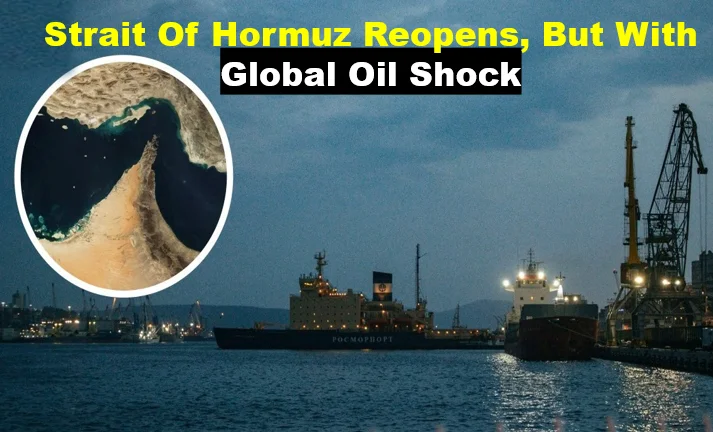

After months of problems that shook businesses around the world, the reopening of the Strait of Hormuz has temporarily calmed global energy markets. Oil ships are once again using the small but strategically important route that links the Persian Gulf to markets around the world. But business leaders and economists think the crisis’s effects could last at least until 2027 and affect prices for fuel, shipping, and food.
One of the most important trade lines in the world is the Strait of Hormuz, which handles about one-fifth of the world’s oil. As tensions rose in the Middle East earlier this year, the route was severely limited. This caused panic on the world’s markets and fears of a long lasting energy crisis.
Why the Strait of Hormuz is So Important
It is between Iran and Oman. The Strait of Hormuz is the primary route for oil from Saudi Arabia, Iraq, Kuwait, Qatar, and the United Arab Emirates to be shipped to other countries. It is used every day by millions of barrels of crude oil and huge amounts of liquid natural gas.
When there were major problems with the road earlier this year, they affected supply lines around the world right away. When the price of oil went up, shipping companies had to stop running their businesses, and the cost of insurance for trucks went up a lot. Asian countries, like India, China, Japan, and South Korea, were among the most at risk because they depend so much on oil from the Middle East.
Read also: Iran’s New Strait of Hormuz Plan Triggers Global Shipping Tensions
Reopening has begun, but there are still risks
According to new reports, several oil and LNG ships have safely crossed the Strait of Hormuz and are now delivering goods to destinations such as China and Pakistan. After months of uncertainty, the movement of ships has given people greater hope that trade lines are stabilizing again.
At the same time, it looks like formal talks between the US and Iran are going forward. Reports say that part of the talks will involve reopening the Strait, easing sanctions, and reducing military tensions in the area. After weeks of ups and downs, oil prices fell as markets responded positively to the news.
However, shipping traffic is still well below normal levels. Many truck owners are still avoiding the area because they are concerned about safety. Insurance rates for ships operating in the Gulf remain very high, and businesses remain wary of disruptions that could recur without warning.
Why experts think the oil crisis could last until 2027
Even though the ports are now open again, energy experts say the crisis has already done long term damage to the structure of global supply lines.
The head of ADNOC, the state oil company of the UAE, says that full oil flows through the Strait of Hormuz might not come back until the first half of 2027. The warning brings up worries that it might take years instead of months to restore market trust and get shipping back to normal.
Disruptions to infrastructure are a big problem. Governments, shipping companies, and energy companies have already started changing supply lines to depend less on the strait. To avoid future problems, countries are putting money into new transportation routes, holding sites, and different pipes.
Natural gas sources are also getting tight. They say it could take years for the Gulf region’s destroyed export systems to fully recover. This has caused Asia and Europe to look for other LNG producers, such as in the US and North America.
Read also: Reports say Iran is proposing a temporary deal under a new Hormuz plan
India and Asia are still under a lot of stress
The issue is still very serious for Asian countries. India gets a lot of its crude oil from the Middle East. If there are problems with the trade lines in the Gulf, it has a direct effect on fuel costs and inflation in India.
Higher oil prices make it more expensive to move goods, make things, and put extra strain on people’s wallets. Asian governments have already had to look at their backup fuel supplies and find new ways to get energy.
China, Japan, and South Korea are also working harder to find other energy lines so they don’t have to rely on a single chokepoint as much. Analysts think that the Hormuz situation could change the way Asia trades energy for good over the next ten years.
Read also: Oil Prices Jump as Trump Warning Raises Hormuz Tensions
A Crisis That Changed Energy Politics Around the World
The problems in the Strait of Hormuz are no longer just about the oil market. It has shown how weak global trade networks are and how quickly political conflicts can have an effect on economies all over the world.
Even though talks are still going on and ships are back on the way, the global oil markets are still unclear. For now, oil prices may have gone down a little, but the disruption is likely to have effects that can’t be seen for years.
Reopening the Strait of Hormuz may end the immediate emergency, but the global oil shock is still going strong. This is the clear message for governments, companies, and consumers.

A versatile writer mainly works on trending news, daily updates from politics, business, crime, current affairs and entertainment.