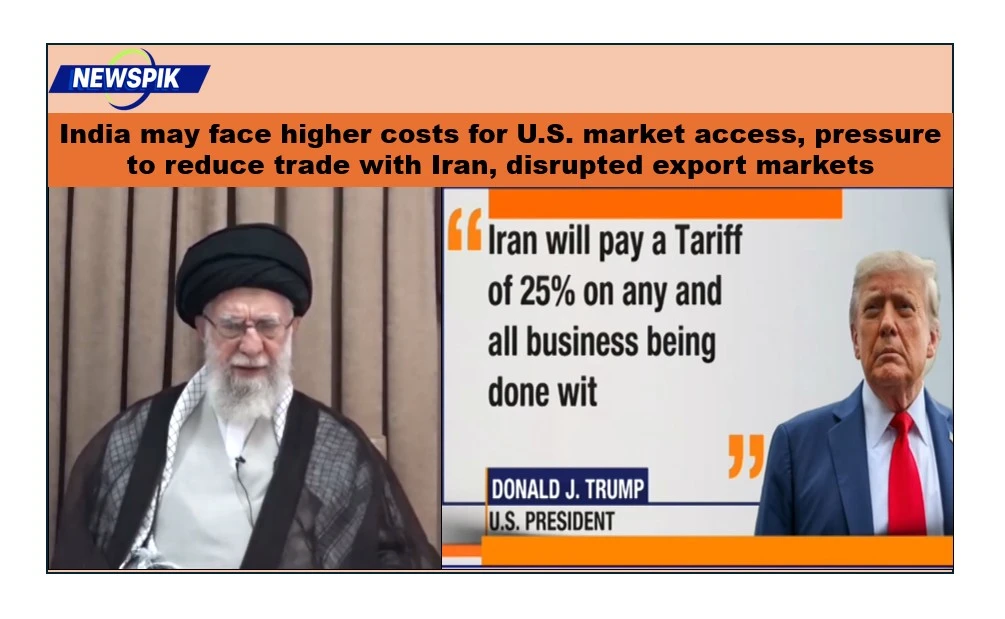

A new wave of anxiety struck the financial corridors of Mumbai and the diplomatic blocks of New Delhi this week. In a “final and irrevocable” presidential proclamation signed Monday, January 12, 2026: Any nation still conducting business with Iran will have to pay a 25% tariff on all trade with the United States.
For India, it isn’t just another trade impediment; looming is the prospect of an economic emergency. Already managing a frayed trade relationship with Washington, New Delhi faces the prospect of its exports to the U.S. being slapped with combined duties as high 75%.
The Calculation of Pain: More Than 50% + 25%
To see why, one has to consider what’s already there. India had already been struggling with a 50% tariff on several export categories, prior to this announcemnt:
- 25% Reciprocal Tariffs: Previously placed as part of a “tit-for-tat” trade showdown.
For Indian sectors such as textiles, gems and jewelry and engineering goods — where profit margins are often wafer-thin — a tax of 75% at the border in America is tantamount to the U.S. market giving notice for evicting them from its shores.
INDUSTRIES ON THE FIRING LINE: RICE AND TEA
The immediate fallout is already visible in the agricultural heartlands of India. Iran is a “pillar market” for Indian Basmati rice and Orthodox tea.
- Basmati: Iran has traditionally represented 20-25% of global basmati rice imports but is now likely to seek broader sourcing in order to mitigate risk. After this release, stocks of leading exporters including KRBL and LT Foods witnessed sudden short-term volatility. Now the U.S. market is effectively closed to those players, too — with a steep 75% tariff barrier in place — and exporters face a hard trade-off: continue business with Iran or ensure their presence in force on the American market.
- Tea: Indian tea exporters were already reeling from a communication blackout in Iran because of the recent protests. The new tariffs represent an additional layer of financial risk that could grind shipments to a complete standstill, as international banks grow that much more wary of processing any transaction linked to Iran.
Iran Sees Fresh Protests, Nationwide Internet Shutdown Continues
The Strategic Casualty: Chabahar Port
Below the balance lines, the Chabahar Port project is the most dramatic strategic victim. Chabahar has long been seen by India as its “Golden Gate” to Afghanistan and Central Asia, circumventing Pakistan.
In 2024, India had signed a momentous 10-year deal to run the Shahid Beheshti Terminal on the port. The US had previously granted waivers for the project, given its significance to humanitarian aid to Afghanistan, but took them away in late 2025. This blanket, one-size-fits-all tariff would effectively make the port closed to business with any Indian company that also wishes to do business in America.
The Diplomat’s Tightrope: Friends or Foes?
New Delhi has also made the announcement at an inconvenient time to leverage it as a punishment. This (2025–26) is the 75th year friendship year between India and Iran. Just last week, Iranian Foreign Minister Abbas Araghchi was in Delhi to commemorate this achievement.
India now confronts its most challenging tactical balancing act so far. On the one side is “Strategic Autonomy” that has long underpinned Indian foreign policy — the right to trade with Russia and Iran in accordance with national interest. On the other is the fact that the United States is India’s largest trading partner and a crucial ally in another China-dominated region, the Indo-Pacific.
Iran warns, US and Israel will be target if Trump administration strikes over protests
Conclusion: A Looming Negotiation
Is there a way out? Barely a month since the bar-and-restaurant owners were shaken by the liquor and marijuana party raid, Abilash has been waiting for a dramatic reversal of expectations with appointment of newly appointed United States Ambassador Sergio Gor who just landed in India to take charge as Washington’s chief diplomatic representative in New Delhi. Discussions are said to be fast-paced to ascertain if India can get something akin to “special status” or exceptions, maybe by showing that it has substantially cut down oil engagement with Tehran.
Persons, however, the window for a “friendly” compromise is small with the kneecap-busting decree of Fire NOW! and his stand-off on Iranian thuggery. The memo for Indian businesses is clear: the price of strategic autonomy was never higher.

A versatile writer mainly works on trending news, daily updates from politics, business, crime, current affairs and entertainment.