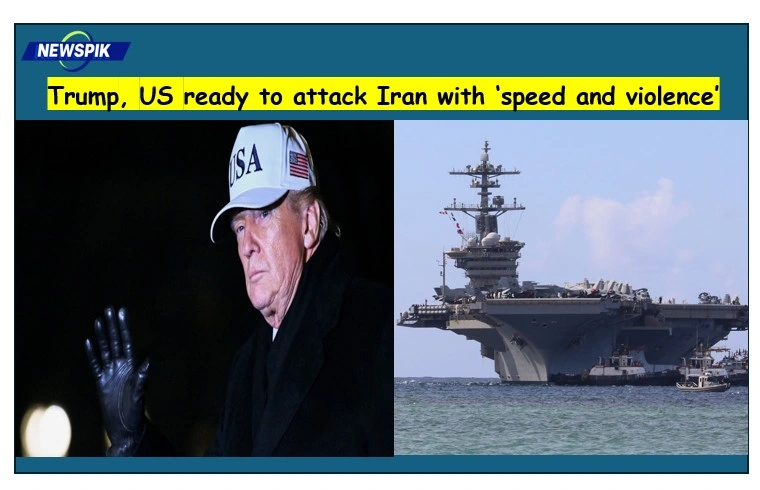

The desperate world of late January 2026 sees a return to the kind of high-wire brinkmanship that seemed consigned to decades past. Wednesday, 28 January saw US President Donald Trump ratchet his rhetoric up to a voie de faits threat of telling some at least in the US Congress that if they did not get a new nuclear agreement with Iran before their committee schedules and timetables run out, then the United States is “ready, willing and able” to attack Iran “quickly & fully”.
The statement, issued over his favorite social media channels and repeated at a rally in Iowa, was not just trash talk. It was an outright ultimatum, and came with the physical arrival of the USS Abraham Lincoln Carrier Strike Group in the Central Command area of responsibility. Trump called this fleet a “massive armada,” and he explicitly compared it to the one that had been sent recently to support the removal of Nicolás Maduro in Venezuela, even saying this new one is “larger, more powerful, and just as maniacally evil as that previous one.
The Phantom of Operation Midnight Hammer
The president’s most recent threat included a particular chilling reference to Operation Midnight Hammer —the June 2025 joint U.S.-Israeli strikes that reportedly levelled a number of Iran’s vital nuclear sites. And as Tehran has sought to minimize the damage and recover over the last six months, Trump’s message was clear: What happened in June was only a beginning.
The change in the White House’s explanation is important. Only weeks ago that domestic repression was the main focus of American pressure, as Iran killed over 30,000 people to quash protests in its own country. But the administration now has turned back to the nuclear file and is calling for all of Iran’s enrichment work to stop, along with all transfer of highly enriched material. This shift in approach reflects an administration that sees the current internal unrest within Iran not primarily as a humanitarian crisis to be confronted, but as something much more: an opportunity to compel a total capitulation of Tehran’s nuclear ambitions.
A Nation Under Siege: The View From Tehran
Within Iran, the mood is a volatile mixture of defiance and despair. The economy is in free fall, with inflation estimated to have reached 60% in just the past month. The currency, the rial, has fallen to historic lows and the regime’s dependence on nationwide internet blackouts and lethal force has not entirely quelled tensions in the streets.
The message of ‘speed and violence’ did not go unanswered by the foreign minister, who warned that it could “not be effective or useful” to carry out diplomacy at “the barrel of a gun”. Behind the scenes, however, there are reports that the Iranian government is preparing for a “decapitation strike”—a blow not intended simply to hit centrifuges but aimed directly at the political leadership.
“Our Armed Forces, with a finger on the trigger, are ready to respond powerfully to any aggression,” Araghchi tweeted — while also making clear that Tehran is willing to return to a “fair and reasonable deal” if it’s approached as such without preconditions.
The Trump administration’s demand for “Zero Enrichment” is a big ask — as good for the Islamic republic as an IED is. Secretary of State Marco Rubio and Special Envoy Steve Witkoff have doubled down on this position, insisting that any deal must also entail a complete halt to Iran’s ballistic missile program and cessation of its support for regional proxy groups like Hezbollah and various Iraqi militias.
Critics of the policy say that, by boxing in a weakened regime, the United States is taking a “Samson Option” risk — that Tehran might decide if it’s going down anyway it may as well take the regional order with it. Already, pro-Iranian militias in Iraq and Yemen have launched “martyr volunteer” recruitment campaigns, signaling a readiness for asymmetrical warfare that could involve attacks on American bases and commercial shipping throughout the Persian Gulf.
Will US Ever Order To Capture Russia’s Putin? What Trump Said
A Region on the Brink
The presence of the USS Abraham Lincoln also put other regional neighbors on the spot. But the United Arab Emirates and Saudi Arabia have both said they want to steer clear of a “hot war” — at the same time as they are most vulnerable to Iranian vengeance. And while many regional powers have said they would not want their airspace used for an attack, the U.S. carrier group’s position in international waters makes those objections largely moot.
The “massive armada” is about to find its resting place, and the diplomatic clock is running. For Trump, the “rapid and aggressive” smack-talk is a weapon of psychological warfare meant to soften up the will of a regime he sees as cracking. To the people of Iran, it’s just another scary layer of uncertainty in a year that has already had too much blood on the streets.
Now the world will watch to see if it is the last act of a long-running geopolitical melodrama, or the opening scene of a new era of chaos that could reshape the Middle East for the next generation.
Trump administration orders enhanced vetting for applicants of H-1B visa

A versatile writer mainly works on trending news, daily updates from politics, business, crime, current affairs and entertainment.