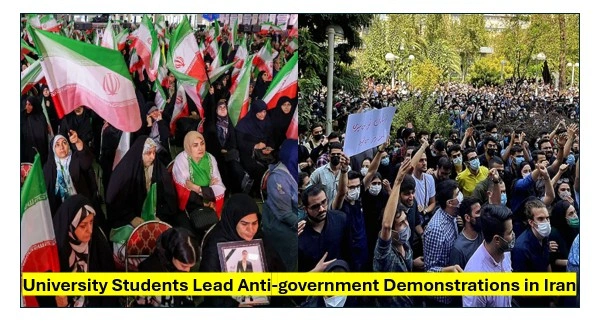

University students throughout Iran have rekindled their large-scale anti-government protests as the school year began on February 21, 2026; this represents the largest display of university unrest since last month’s bloody crackdown on nationwide demonstrations.
Students Rekindle Nationwide Anti-Government Protests
Hundreds of students gathered at major campuses including Sharif University of Technology, Amir Kabir, Beheshti University, Mashhad University, chanting anti-regime slogans in honour of those who have died during the previous round of protests.
Protesters invoked traditional mourning ceremonies, which occur 40 days after deaths, to help them gather large crowds to mix memorial service with political rage.
Slogans, Demands and Symbolic Protest
Throughout Tehran and other cities, students chanted prominent slogans such as “Death to the Dictator” and “We will Stand to the End”, which specifically addressed Supreme Leader Ayatollah Khamenei and Iran’s clerical ruling class.
Protests were full of anti-regime expressions, as well as confrontations between the anti-regime demonstrators and pro-government supporters (or forces) demonstrating the widening gaps in Iranian society, particularly between young and educated Iranians.
Many demonstrators raised the national flag while demanding that the Iranian government undergoes profound political change, while others called for Reza Pahlavi, the exiled son of the former Shah of Iran, to be restored as the Iranian monarch.
Read also: 19 year old student argues in Supreme Court for his MBBS seat
Clashes With Security Forces and Militia
In multiple universities Across Iran, the protests by students at several institutions have led to violence and confrontation with members of the Basij militia and other groups aligned with the Government. Many videos of these incidents have been posted online and documented by other international media outlets; you can see groups of students yelling “Shame on you” at armed students who have volunteered for the militia and are attempting to participate in the Government-backed protests.
On some campuses there was an increase in security, including restricting access to campus facilities and an overall increase in coordination between the Basij and the police who are in the vicinity.
There is also evidence that there are confrontations occurring at a few of the events, where both sides accuse the other of aggression.
Inevitably, the timing of this protest correlates with the observation of the traditional mourning period, which occurs after 40-days of the death of any person, and coincides with the demonstrations which took place last month (and were the most violent riots in the past 35 years) since the 1979 Iranian Revolution.
In particular, students used the memory of the deceased to unite against the Government; therefore, using the memorial services to unify and demonstrate against the regime was accomplished by many students blending grief with political change.
There are memorial services for the deceased that are state-sponsored that may have started out, as far as students were concerned, to be peaceful in nature; however, as they progressed they evolved into students chanting slogans that relate to their political beliefs.
Universities have repeatedly become focal points for political dissent in Iran, with students historically at the forefront of movements pushing for social and political reform.
Read more: Iran Sees Fresh Protests, Nationwide Internet Shutdown
Looking Ahead: Unrest and Uncertainty
Iran is currently balancing numerous internal issues amidst a wave of protests sweeping across the country. These include managing the growth of popular dissent in Iran, responding to international pressure and meeting growing internal demands from Iranians for improvement and accountability in governance. According to analysts, student activism can play a significant role (potentially, positively) as it relates to widespread social unrest; thus, there is potential that student activism could have a major influence on how Iran will look over the next several months.

A versatile writer mainly works on trending news, daily updates from politics, business, crime, current affairs and entertainment.