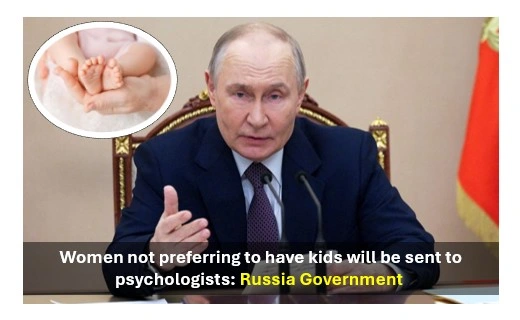

The Russian Ministry of Health has released clinical guidelines stating that women who don’t want to have children must be referred to counseling. For instance, during routine reproductive health exams, professionals will ask all female patients if they intend to give birth; if they respond that they do not want or plan to have any children, they will then be sent for counseling to help them adopt a positive attitude towards childbirth.
The motivation for this new guideline appears to be a government push for more of its citizens, particularly women, to change their minds and plan to become mothers.
The new guidelines were designed to help address Russia’s demographic crisis. As a result, the number of new births has fallen, the number of people in Russia is decreasing, and the number of deaths is increasing. The current statistics indicate that the number of births in Russia is at an all-time low, and the number of children born into a family is lower than necessary for the population to remain stable.
President Vladimir Putin has talked about the declining population and has indicated that this decline represents a serious threat to Russia’s future as a country.
The ongoing war against Ukraine and the related loss of young people from Russia have worsened the demographic crisis because there are fewer young people in Russia who can have children.
What the Guidelines Say?
Under the new policy:
Regular assessments of women’s reproductive health will occur across the age range from 18 to 49. Doctors will inquire about the desired number of children, but if the woman states explicitly that she does not want to have children, she may be referred to a psychologist.
While some sources claim that both men and women will receive questionnaires, it has been noted that the women are the ones being sent for psychological consultations with regard to childbirth decisions.
Wider Pro-Natalist Initiatives
This proposal is not an isolated incident. This is part of a larger trend of policies intended to promote increase birth rates in Russia. Other examples of these types of policies include:
- Providing financial incentives for families which have children
- Increasing restrictions on access to abortion
- Promoting “traditional” family values
- Introducing legislation aimed at reducing the effects of the “child-free” movement
State officials have made statements praising large families and established state awards for women who raise large families, promoting pro-natalist messages.
Read also: China taxes condoms, contraceptive drugs in bid to spur birth rate
Criticism and Concerns
Critics have expressed concern that this proposal infringes on individual liberty and the autonomy of women. Additionally, critics of the proposed policy contend that proposal has the potential to classify a woman’s decision regarding whether or not to have a child, as a psychological issue, thereby providing an avenue for outside intervention in a personal decision or choice made by the woman.
Additionally, there have been concerns regarding possible gender bias due to the lack of emphasis placed on similar psychological referral requests for males. There are critics of this as well who cite that measures taken may increase pressure on females, and not account for all of the broad social and economic issues behind how families make their decisions.
Broader global context
Russia is not the only nation experiencing declining birth rates. Many nations are experiencing similar issues with their demographics, however, Russia’s involvement of state incentives, cultural messaging, and also adding the option of referring women to psychologists for their childless state, sets it apart from other countries that have been known to pursue these types of policies.
It is also commonly stated that there are much longer long-term solutions n for addressing the issue of a declining population. These solutions often include improving standards of living, job security, and childcare support instead of compelling someone to have children.
Read more: The Digital Dynasty: Why a Chinese Billionaire Wants 20 American Sons
Conclusion
Russia’s new program to refer women to be examined by psychologists emphasizes the issue of demographic decline. Although one would think that this would reverse the issues of declining birthrates, there are many ethical and social questions around allowing individuals to have personal choices, desire for government intervention, and female roles in society.

I am a versatile content writer from the MP region, covering politics, business, crime, current affairs, entertainment, video games, and sports with clear insights, engaging analysis, and timely, reader-focused updates.