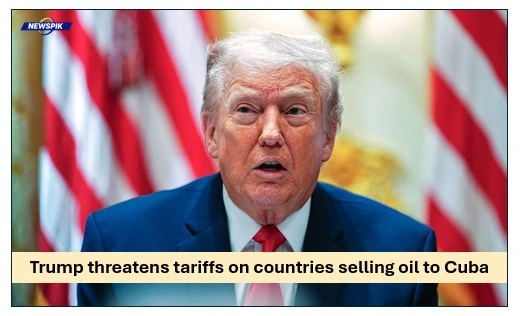

The geopolitical reality in the Caribbean has changed drastically this week, after US President Donald Trump issued a far-reaching executive order intended to cut the last boom ropes holding up the Cuban state. By warning that it would impose hefty tariffs on any country that sells or provides oil to the island, the administration conveys what may be a new, and possibly final, phase of the decades-long “ Cold War ” in the Caribbean.
This is not only about trade but also about a fundamental change in how the United States makes economic muscle a tool for regional politicking. For the people of Cuba, these are existential stakes. For the rest of the world, it is a masterclass in market access as an instrument of diplomacy under American First.
The Executive Order: Shutting Off the Lights
On January 29, 2026, President Trump declared a national emergency stating that Cuban relations with “hostile foreign powers,” in particular Russia and armed groups such as Hamas and Hezbollah which Cuba was hosting represent an “extraordinary threat” to U.S. national security. The resulting executive order gives the Ministers of foreign affairs and Commerce the ability to analyze and apply furders ad valorem duties to imports from any country providing oil either directly or indirectly to the communist-ruled government.
It is an argument from the White House that is both blunt and strategic: If you want to sell your products in the world’s largest economy, you cannot help power one of its leading adversaries.
“Cuba is going to be in a lot of trouble soon,” Trump said to reporters. “They had the money from Venezuela. They bought the oil from Venezuela.
This is a reference to the U.S. military action, earlier this year, which resulted in Venezuelan leader Nicolás Maduro being deposed and arrested — blocking instantly Havana’s access to its cheap source of crude. With Venezuela off the grid, “the last lifelines keeping electricity flowing to Cuba” are now on the Trump administration’s chopping block.
Trump Imposes 10% Tariff On Denmark, UK, France For Opposing
Mexico in the Crosshairs: A Diplomatic Juggling Act
The immediate and most important victim of this executive order is Mexico. Mexico, under the administration of President Claudia Sheinbaum, has become Cuba’s chief oil supplier (including a recent daily average of nearly 20,000 barrels). This support has been cast by Mexico City as an “act of solidarity” and humanitarian assistance to a neighboring country in the grip of a devastating energy crisis.
But the supposed “solidarity” of the Sheinbaum government is now coming up against the cold facts of U.S. trade policy. The plan to begin imposing 25%to 50% tariffs on a vast array of Mexican exports — from cars to agricultural goods — would be crushing to the Mexican economy.
The tension is palpable:
The Mexican Stance: Sheinbaum has accused the U.S. of meddling in Mexico’s sovereignty and said that its state-run oil company would honor existing contracts TheNationalReview.com Pirate? She has described the shipments as a humanitarian way of preventing a complete humanitarian breakdown on the island.
Trump slaps tariff on Iran’s trade partners. How will it impact India?
A Nation on the Edge: The Human Cost in Havana
If the high-level diplomatic chess match is playing out in Washington and Mexico City, on the ground in Cuba the effects are nothing short of devastating. For months now, the island has been suffering from rolling blackouts that can last as long as 18 to 20 hours a day. When those fuel reserves run out, the power grid will collapse into an entirely new scenario and no longer a “worst-case” one: Total failure within two to three weeks — 15 to 20 days — if oil lasts that long.
The human toll of this crisis is plain on every street corner:
- Transport Paralysis: Public transport, too, has come to a grinding halt, with thousands walking kilometers in the heat.
- Food rot: The limited quantities of food that the average Cuban family can afford are spoiled without a refrigerator.
- Hospitals Under Siege: Hospitals are struggling to operate basic equipment, relying on aging generators that often fail.
And in cutting off the fuel, the U.S. is not just targeting the government; it is bearing down on the tapestry of everyday life. The Trump administration has bet that this “maximum pressure” will bring the Cuban leadership to the bargaining table — or foment a homegrown uprising that topples the regime from within.
Conclusion
President Trump’s message to Havana has remained the same: “Make a deal before it is too late.” He has implied that we are only headed for collapse. For the Cuban government, “the deal” would conceivably entail a winding down of its one-party system and a fundamental reorientation of its foreign policy — concessions that the Communist Party has refused to consider for more than six decades.
Now, as we enter February 2026, the question is not whether or not the U.S. can isolate Cuba but rather how much longer the island can manage to survive without one of its most essential needs: energy. Now that Venezuela is off the map, and Mexico under fire, that “lifeline” is unraveling.

I am a versatile content writer from the MP region, covering politics, business, crime, current affairs, entertainment, video games, and sports with clear insights, engaging analysis, and timely, reader-focused updates.