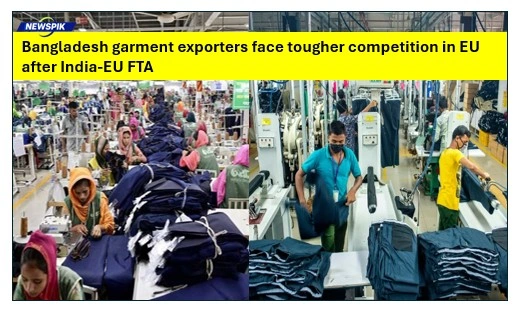

For almost half a century, the words “Made in Bangladesh” have been synonymous with cheap clothes in Europe. And following the European Union’s Everything But Arms (EBA) scheme, Bangladesh blossomed from a new nation into the world’s second-largest garment exporter. But the 2026 dawn has thrown a game-changing kink into that cozy set-up.
With the recent signing of the India-EU Free Trade Agreement (FTA), or “Mother of all Deals” as it is often referred to, the world textile field is being redefined. For the first time, Indian clothes makers will have same zero-duty access that had brought Dhaka its “unfair” advantage. This is not a minor policy adjustment; this is a major attack on the economic backbone of Bangladesh.
A level playing field with lots of sharp edges
The most significant cause of anxieties here is the elimination of tariffs on a large scale. In the past, Indian textiles entering the EU were subject to duties of between 9% and 12%. This wall of tariffs worked as a shield for Bangladesh, enabling its factories to sell at more competitive rates despite the cost of production in India being cheaper.
Under the new F.T.A., that wall has come tumbling down
- Graduation Shock: Complicating the issue is the success of Bangladesh itself. The country is set to graduate from LDC status in November 2026, but could lose all EBA preferences by 2029.
- The 24% Swing: Analysts fear a “double whammy.” India, meanwhile, is dropping from 12% duty to a zero percent.DutyBangladesh could go from zero percent to a 12% tariff should it not be able secure GSP Plus status. This is a massive 24% swing in relative pricing.
The consequences are monumental, says Mustafizur Rahman, distinguished fellow at the Centre for Policy Dialogue. Unless it pivots fast, “Bangladesh will structurally become less competitive in its most important market.
India’s “Backward Linkage” Advantage
The visible change is in tariffs but the deeper menace is the supply chain. Bangladesh has a deep skill bag at CMT (cut, make and trim) ranging but continues to import most of its fabric. Ironically, many of the Bangladeshi factories use cotton yarn and fabric from India.
India’s textile industry is vertically integrated meaning they control the production process from the cotton field to the finished shirt. That gives Indian exporters a few important strategic edges:
- Cheaper Inputs: Indian factories can source raw cotton and other inputs locally, without paying international shipping and import tariffs.
- Shorter Lead Times: With yarn and fabric production in-house, Indian manufacturers can react to “fast fashion” trends a lot faster than Bangladeshi factories that are waiting for fabric to arrive from abroad.
- Product Diversity: Bangladesh can control basic products such as T-shirts and denim, but India’s product line is much more extensive, including high fashion, complex embroidery (apparel), man-made fibers.
The Pressure on Profit Margins
The completion of this trade deal couldn’t have come at a worse time for Bangladeshi exporters. The weakened demand and a buyer power shift already has the global economy of 2026 struggling. European retailers, grappling with their own inflationary pressures, are themselves using the India-EU FTA issue as a bargaining chip.
There’s not a lot of fat left to trim in an industry already operating on razor-thin margins. A new study suggests that Bangladeshi exporters could be forced to swallow 40% of future tariff costs in order to remain competitive. This financial pressure has endangered needed investments in green energy and factory safety — fields in which Bangladesh had, in fact, become a global leader over the past few years.
A Wake-Up Call for Innovation
If there could be a silver lining, it is that this crisis is precipitating a long-needed “reboot” to the Bangladeshi garment strategy. Many in the industry had warned for years that “cheap labor and zero duty” was a time bomb.
The Race for GSP Plus
Maintain the status of GSP Plus from EU is now a national compulsion. To qualify, Bangladesh must respect 27 so-called international conventions on human rights, labor rights and environmental protection. Though the country has made huge gains in factory safety, the EU is already scrutinizing trade union rights and judicial independence.
Moving Up the Value Chain
“Basic $2 T-shirt” times are over. Bangladesh is now tilting toward high-value products: sportswear, technical textiles and high-fashion outerwear. By adding “smart” manufacturing and automation, the factories hope to make up for the loss of tariff advantages with better efficiency and quality.
The road ahead: 2026 and beyond
Make no mistake, the India-EU FTA is a wake-up call, not an obituary. The infrastructure, the level of skill and number of workforce at the Bangladeshi RMG are physically overwhelming.
But the “grace period” is up. The next three years will be critical to whether Bangladesh continues as a global powerhouse in apparel or falls behind an ascendant India. The work of recovery will not be accomplished with sewing machines alone; it will require high-level trade diplomacy, a radical turn toward sustainability and the courage to transcend the low-cost model that built the nation.

I am a versatile content writer from the MP region, covering politics, business, crime, current affairs, entertainment, video games, and sports with clear insights, engaging analysis, and timely, reader-focused updates.