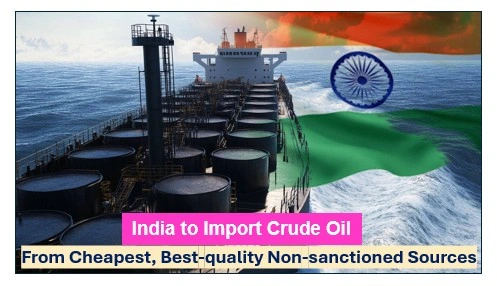

In the ever shifting chessboard of global energy politics, India has a simple and bold philosophy: that for it and many developing countries, its claim is not just a policy but a sovereign right. Subsequent to that, on February 10, 2026, the Indian government repeated this “1.4 billion people first” position in front of a Parliamentary Standing Committee (when told it should source oil from U.S.) and confirmed that the country would continue its policy of buying crude from wherever it is cheaper and of better quality and non-sanctioned.
The announcement comes at a sensitive time. With the shifting of trade leadership in the United States and global markets reeling from “weaponized” commerce, India’s strategy is a lesson in economic survival married to diplomatic finesse.
The “Pragmatism First” Doctrine
Behind India’s energy strategy lies a simple mathematical fact. When global prices change, it is not just companies’ balance sheets that are impacted; it finds an echo in the price of a liter of petrol in a small village in Bihar or the cost of carting vegetables to a market in Chennai.
This is what the MEA and Ministry of Petroleum have stated emphatically: India will not be arm-twisted into buying expensive fuel to meet alien geopolitical needs. And if a barrel is discounted and the transaction doesn’t violate international law, Indian tankers will be there to pick it up.
The Shift Toward “Non-Sanctioned” Stability
For India made good use of cheap Russian oil between 2022 and 2025, but as early in the year of 2026 things were rather different. India has shifted and repositioned itself strategically, as the U.S. sanctioned some of Russia’s biggest entities in late 2025.
- Selective Russian Buying: India has not terminated purchases from Russia, but purchases stateside are now “driven by compliance.” Refiners are currently counter-balancing sanctioned Russian entities to avoid falling into “snap-back” U.S. tariffs.
- Return of the Middle East: Established partners such as Iraq and Saudi Arabia are reclaiming lost market share in India. Iraq is again giving Russia a run for its money as India’s No. 1 supplier.
- Venezuelan “Wildcard”: In the wake of recent easing of some energy sanctions levied upon Venezuela as politics shift in that Latin American country, Indian state-run refiners such as IOC and HPCL have already booked millions of barrels of heavy Venezuelan crude (Merey grade) for delivery in April 2026.
- Quality Over Cost: “Not Cheap” Is Not the Measurable Standard It’s the Same Deal with Any Other Product If an apple is in rough shape, you won’t offer your best price for it.
Not all “black gold” is the same in the oil world. You can think of a refinery as it you would a finicky kitchen –you need the right ingredients if you want to get the best cake. That’s thanks to extensive upgrades in India’s refining sector, which has invested heavily in equipment that can handle both “heavy-sour” crude (or, the type from Venezuela) with as much ease as “light-sweet” (the kind from the U.S).
The Quality-Price Sweet Spot:
- Russian Urals : Provides a medium-sour barrel which suits Indian refineries well, but currently also accounts cost of higher compliance “red tape”.
- U.S. Crude: Generally a high grade with light weight, which should carry less of a premium and expensive shipping costs because it is delivered over shorter distances.
- Middle East Grades: The optimal logistical reliability and “execution-reliability”, the lowest transit times of Arabian Sea.
Conclusion: A Sovereign Energy Map
India’s bet on energy in 2026 is no longer about picking sides between the “East” and the “West. It is about an agnostic alignment model where there is permanent commitment only to the Indian consumer. India has effectively made sure that its “energy kitchen” never runs short of ingredients — with no fewer than 41 sources today, up from around 27 a few years ago — no matter the geopolitical weather.
As the partial trade deal with the U.S. nears finality in March 2026, there is going to be more “Made in USA” oil flowing into Indian refineries, but that doesn’t mean India will lock out any other supplier that meets the golden criteria: The three lines ARE: Affordable, Reliable and Legal.

I am a versatile content writer from the MP region, covering politics, business, crime, current affairs, entertainment, video games, and sports with clear insights, engaging analysis, and timely, reader-focused updates.