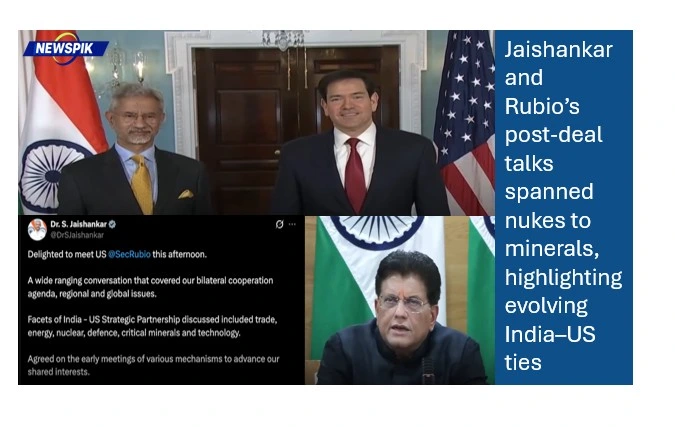

Something new seems to be happening except for the corridors at the U.S. State Department and it is still early February 2026. As President Donald Trump and Prime Minister Narendra Modi inked what was called the “mother of all deals” — a trade pact that saw both sides slashing reciprocal trading tariffs from 25% to 18% — within 24 hours, External Affairs Minister S Jaishankar met U.S. Secretary of State Mike Pompeo to ensure that the economic breakthrough translated into larger political dividends for long-term strategic partnership between India and the U.S.
Beyond the headline 18% tariff figure scores dominated by the Jaishankar-Rubio meeting on February 3, 2026, took up “unseen” architecture of the century –the Nukes to Minerals transition. This shift is away from traditional security guarantees and toward the security of supply chains that will underpin the century of artificial intelligence, clean energy and advanced warfare.
Trade Deal Is Just a Start to a New Chapter on Energy
For decades, the India-U. S. relationship was the Civil Nuclear Deal of 2008—a transformative deal that removed India’s nuclear pariah status. Yet for almost two decades, an obstacle called the “liability barrier” kept American reactors off Indian soil.
Jaishankar and Rubio recognized this tectonic shift during their February 2026 meeting, which was acknowledged by the two. India has established with the passing of SHANTI Act (Sustainable Harnessing of Advanced nuclear TechnologY) that had erstwhile put legal impediments in facilitating collaboration, have been snaffled.
- Small Modular Reactors (SMRs): The conversation shifted from giant, slow-moving plants to nimble SMRs that can be situated in close proximity to industrial hubs.
- Private Sector Integration: For the first time American businesses – Westinghouse, GE, et al- can compete in a marketplace that is no longer state monopolized.
The “New Oil”: Protecting the Supply Chain of Critical Minerals
If nuclear power is the legacy, Critical Minerals are the future.” Jaishankar’s visit came at the time of the very first Critical Minerals Ministerial, a meeting of more than fifty countries initiated by Rubio in order to dismantle China and Russia’s international monopoly on rare earth elements.
The two leaders’ conversation underscored a common concern: that Trump’s “America First” policy is in danger of transforming us from a military and economic superpower into the world’s largest gated retirement community, sitting on more than 10,000 regional McMansions while our Pacific front yard is controlled by China.
Project Vault And The 500 Billion Promise
One of the more revealing aspects of the larger trade agreement – that Jaishankar and Rubio “tweaked” – was India’s “past intent to import”. President Trump’s declaration of a $500 billion purchase over five years — an eye-popping sum that raised eyebrows at the time — ultimately had context provided by Jaishankar-Rubio talks about how that money would be spent.
It’s not just about buying American goods; it is about investing in Big High-Tech Infrastructure:
- Data Centers: Large-scale purchasing of US kit, servers and cooling.
- AI Chips: Sure bet on advanced semiconductors.
- Hydrocarbons: To raise the contribution of U.S. crude and LNG in India’s energy basket to 15-20%.
“We are not trading goods, we are associating our futures,” one senior official said after the meeting. “From ‘Nukes to Minerals’ signifies a shift from disaster prevention to prosperity creation.”
The Geopolitical Dimension: The Quad and the Indo-Pacific
Though the agenda was economic, regional security cast its shadow. They also reiterated their commitment to Quad (India, U.S., Japan, Australia). Though many had feared initially that under the Trump administration, multilaterals might take a back seat, the Jaishankar-Rubio conversation suggested otherwise.
The Quad is being reconceived as a “Economic Security” bloc. The four nations are forging a “trusted geography” for technology with formal cooperation in critical minerals and nuclear power. Rubio’s dream of a “prosperous and free Indo-Pacific” now has a material foundation: if the Quad controls the minerals and the tech, it owns the regional story.
A Humanized Approach to Diplomacy
This version of India-U. The tone is what sets S. relations in the past, say diplomats and political analysts. The so-called transactional approach associated with the Trump-Rubio doctrine was answered with Jaishankar’s own signature “principled realism.”
The conversation was “candid and peer-to-peer,” described one participant. The days of the U.S. as a patron and India as a supplicant are over.” But Rubio and Jaishankar talked about all this as CEOs of two huge businesses hammering out a merger. They conceded the friction — like selling into a 50% “punitive” import tariff regime for what was once a mutual aid snack — but preferred to focus on the 18% “opportunity” that lay ahead.
The Road Ahead: What Happens Next?
It was decided at the end of the meeting that early sessions of bilateral mechanisms would be held including those like iCET (Initiative on Critical and Emerging Technology) and 2+2 Ministerial.
Now that Jaishankar is returning to New Delhi, the high-level diplomacy shifts to technical implementation. The international community will be watching to see if the “Nukes to Minerals” roadmap holds up under global market volatility and domestic political pressure. The one certainty is that the India-U. S. engine is no longer merely idle on the tarmac; it has taken off down the runway.

A versatile writer mainly works on trending news, daily updates from politics, business, crime, current affairs and entertainment.