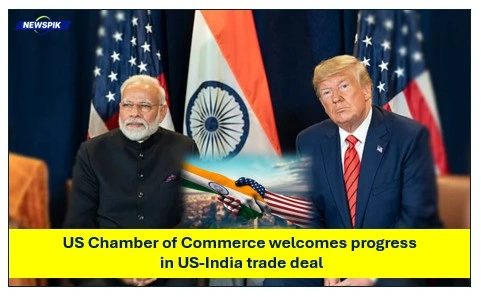

In a game-changer for world trade, the US Chamber of Commerce has given its formal approval to the fresh trade development between India and United States announced at UN. On Tuesday, Feb. 3, 2026 — C.E.O.s Have Been Eulogized; Say Welcome to February 3, 2026 (Business) - The doors of the world’s biggest business organization swung open today in a resounding welcome given what many had started to fear was a deal stuck in an eternal diplomatic cul-de-sac.
Industry titans are greeting the announcement, which represents a drastic cut in tariffs and a shift to unconventionally sourced energy geopolitics, as the “first light” of an all-encompassing bilateral trade agreement. For the thousands of ambitious businesses that operate up and down the corridor which runs from Silicon Valley to Bangalore, this isn’t simply about policy — it is about returning some predictability to an increasingly unpredictable world market.
A Strategic Sigh of Relief: Suzanne Clark’s Vision
Praising the announcement, U.S. Chamber of Commerce President and CEO Suzanne P. Clark described the news as a hard-fought win for both countries. Clark, who travelled extensively throughout Delhi and Mumbai last year, said that the economic ties between America and India have reached a point where it is now “the most consequential” relationship in the world.
The optimism in the Chamber isn’t just symbolic. It is the unified voice of the U.S.-India Business Council (USIBC) and its members who have been advocating for a roll back of “tit-for-tat” duties that had stifled SME growth for nearly two years.
India–US Trade Deal: How the Needle Has Moved in Bilateral Trade
The Numbers That Count: From 50% to 18%
The guts of the advance is a tariff revolution. For most of late 2025, Indian exporters would have to pay an eye-watering 50 per cent effective tariff on any goods they sold into the U.S. That was a 10% basic duty, to which was added a 15% retaliatory tariff and a punitive 25% rider that was pegged to India’s increasingly unpalatable decision to buy more Russian oil.
According to the new deal as laid out by President Trump:
Indian Commitment: In return, India has made a commitment to buy more than $500 billion worth of American energy, technology and agricultural products.
For an Indian exporter of textiles or an American electronics company, these numbers can mean the difference between a bustling order book and a shuttered factory. And the lifting of the “oil penalty” is especially significant, it said, an indication that Washington is willing to offer some geopolitical relief in exchange for economic cooperation.
Here’s a quick look at the new deal, as explained by President Trump:
The Reciprocal Tariff has lowered the per cent to 18 from 25.
Indian Commitment: India, in response, has committed to purchasing more than $500 billion worth of American energy, technology and agricultural products.
For an Indian exporter of textiles, or an American maker of electronics, these numbers can represent the difference between a booming order book and a shuttered factory. And the lifting of the “oil penalty” is especially symbolic, it said, a sign that Washington is ready to provide some geopolitical breathing room if commercial interests lead to cooperation.
“It’s not just a victory for the billionaires,” says a merchant in Jaipur’s jewelry district. This rate of 18%,” he said, “is our chance to survive.”
On the American side, the U.S. Chamber said the deal would help cool domestic inflation. The “invisible tax” on American consumers is effectively being reduced by allowing U.S. manufacturing to use less expensive Indian inputs, from chemical precursors to steel parts.
India-U.S. ‘very close’ to finalising initial framework deal on reciprocal tariffs
The Challenges Ahead: Is This Only Phase 1?
Even as the atmosphere is festive, US Chamber and US-India Strategic Partnership Forum (USISPF) have both warned that this was just the beginning. The agreement is being seen as ‘Phase One’ of a wider Bilateral Trade Agreement (BTA).
Remaining Friction Points:
- Non-Tariff Barriers: Legal and regulatory impediments and certification burden continue to affect medical device, pharmaceutical industries.
- Labor Standards: American negotiators are pressing for tougher labor and environmental regulation in Indian manufacturing hubs.
- The “Russian pivot”: Although somewhere down the line, India has pledged to curtail buying Russian oil in favor of U.S. and possibly Venezuelan oil, it will take years — not months — for those logistical changes to materialize.
Summary: Together We Prosper, Mega!
The US Chamber of Commerce’s alignment with the Trump-Modi agreement represents a relatively rare moment of cooperation between the private sector and the executive branches of both governments.
As India’s external affairs minister, S. Jaishankar, put it during his current visit to Washington, the deal will “spur growth and promote innovation,” which can reinforce the “Make in India” initiative even as it feeds America’s “America First” manufacturing fire.
There is still a long ways to go to meet a $500 billion trade target, but couldn’t the path at least now be cleared of boulders of punitive tariffs?

I am a versatile content writer from the MP region, covering politics, business, crime, current affairs, entertainment, video games, and sports with clear insights, engaging analysis, and timely, reader-focused updates.