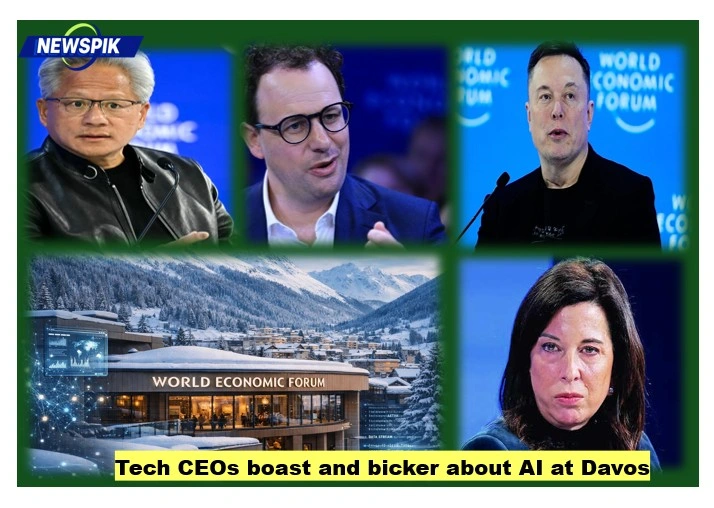

High in the snow-draped mountains of the Swiss Alps, this year’s World Economic Forum (WEF) at Davos has already stripped off its own veneer of diplomatic cliche and polite networking. In its stead, there is a raw, high-stakes verbal slugfest. The latest public phase of the “AI Arms Race” has now begun, with Silicon Valley’s titans and the world’s greatest chipmakers going from quiet competition to open bickering.
What used to be a coalition of “AI for Good” is now being torn apart by raging debates on national security, on “ fake ” AGI, and on the morality of digital advertising. Sam Altman, Satya Nadella, Jensen Huang and Dario Amodei are our four horsemen of AI: they don’t ride in on horses but perhaps autonomous electric cars strapped to rapid reinvention at industrial scaleThe message is clear as they take the stage: The AI honeymoon is over — time to turn your client-server model upside down and head for 21st century superpower status.
‘Nuclear Weapons’ and Boardroom Betrayals: The Amodei vs Nvidia Clash
Among the potentially most incendiary moments of the summit was a talk by Dario Amodei, CEO of Anthropic. To the surprise of the audience in a packed hall at the “Geopolitics of Intelligence” panel, Amodei lashed out at his own majority investor, Nvidia.
The bone of contention? Last month, Nvidia agreed to continue supplying advanced H200 AI chips to China for the U.S. olitical system response— according to a 25% revenue-sharing deal with the United States. Amodei didn’t mince words, likening the sale of high-end AI hardware to rival nations to “selling nuclear weapons to North Korea.”
The friction is tangible as Anthropic’s own raison d’être requires the GPUs Nvidia offers. That a CEO deemed it expedient to denounce this familiar cliché on such a public stage as Davos can only mean one thing: that the new ethical and geopolitical risks of AI are starting to eclipse old-fashioned corporate self-interests.
The “AGI Marketing” Feud: Google DeepMind Attacks OpenAI
Amodei zeroed in on the hardware; Demis Hassabis, CEO of Google DeepMind, focused on the software (and in particular OpenAI’s Sam Altman).
Altman, for his part, has doubled down on the “whooshed by” AGI man and claimed that we have already zipped past it to a world of super-intelligences. Hassabis, preeminent scientific lead at Google, wasn’t having any of it. In a session called The Spirit of Dialogue, Hassabis even asked, “Isn’t it the big irony” after OpenAI recently decided to run ads using ChatGPT.
- The Irony: “If AGI is really just around the corner,” Hassabis joked, “why would you need ads? You don’t build a search engine for a god; you build it for a profit margin.”
- The Accusation: AGI was being turned into a “marketing term” instead of an accomplishment in science, Hassabis warns, and the pivot to ad-revenue suggests that OpenAI has been running strong on monetary fumes as opposed to technical breakthrough.
Elon Musk Holds Surprise Talk At The World Economic Forum In Davos
Infrastructure vs. Bubbles: The Nadella and Huang Counter-Story
In the midst of all this sniping, the “grown-ups in the room” — Microsoft’s Satya Nadella and Nvidia’s Jensen Huang — tried to get everybody on a topic that everyone at The Times (well, not me) is obsessed with now: trillions being spent on infrastructure.
Satya Nadella’s “Zero-Sum” Rejection
Nadella, reflecting on his 34-year history at Microsoft, quoted the philosophy of Peter Thiel: “Competition is for losers.” His point? Microsoft is not focused on what Google or Meta are doing; it is focusing on its customers’ needs. He also rejected the notion of a “winner-takes-all” outcome, asserting that the Total Addressable Market (TAM) for AI is so big that it will eventually come to represent more of world GDP than the internet ever did.
Jensen Huang’s “Industrial Revolution”
Jensen Huang, the man who could be said to have held the keys to the kingdom and yet gave them all away for free, described this current fever dream about AI not as a bubble but as “the largest infrastructure build-out in human history.” He also referenced the five-layer energy, chips, cloud, models and apps stack pointing out as long as cost of rental compute continue to be high and capacity remains constrained …a “bubble” idea is mathematically premature.
Elon Musk’s Rich Future (and His Major Robotics)
In one of his signature dramatic turns, Elon Musk paid a rare visit to Davos to predict the day when robots will outnumber humans. As other chief executives fought about chip sales and ad revenue, Musk described a vision of an “abundant future” in which Tesla’s humanoid robots divorce labor from cost.
But even Musk’s enthusiasm was tempered by an old warning: AI has a “non-trivial” chance of destroying civilization as we know it if people don’t tread lightly with its potential. His presence was a reminder that, as much as the CEOs may bicker over stock prices, it’s really about who gets to author the rules for the most transformative technology in human history.
Conclusion: The New World Order
The legacy of Davos 2026? As those private jets take off from the Engadin Valley, it’s that tech has lost its innocence. The chief executives are no longer just people building apps but the shadow diplomats and interpreters of geopolitical winds.
The sniping we saw this week is a symptom of a greater truth: AI isn’t just a tech story anymore. It’s a trade story, a war story, and a survival tale. When the stakes are that high, the gloves don’t simply come off; they go in the fire.

A versatile writer mainly works on trending news, daily updates from politics, business, crime, current affairs and entertainment.