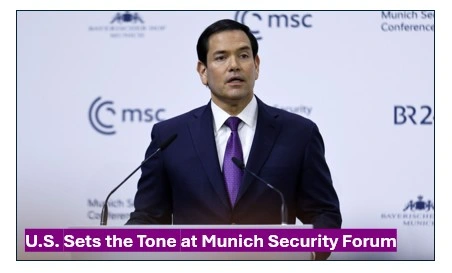

At the recent Munich Security Conference held in Germany, United States Secretary of State Marco Rubio delivered a keynote speech aimed at restoring friendly relations between the US and its continental partners. Following numerous fallouts over past criticisms levelled by US officials against Europe, Rubio adopted an improved tone of diplomacy to reassure Europeans of the longstanding historical ties and shared culture of the US and Europe, noting that “America and Europe belong together”.
U.S. Seeks to Reassure Europe Amid Alliance Strain
Rubio outlined the US-EU partnership as key to the success and advancement of western culture and security, while also recognising there is a “historic moment” occurring within the context of the continuously changing global environment. Compared to his predecessor Vice President JD Vance, who delivered an antagonistic speech last year accusing European leaders of not being able to fulfill their obligations to the US, Marco’s discussion highlighted areas for future collaboration rather than concentrating on areas of past failures.
Balancing Reassurance with American Policy Priorities
Although Rubio was more conciliatory towards Europe’s challenges than other US representatives that attended this forum, he will uphold positions relating to US policy, including citing serious issues related to European immigration policies and re-stating that further collaboration will depend upon mutual approaches to immigration, trade, security, and defence functions.
U.S. officials were clear in their speeches and comments on the sidelines that they want Europe to take on more responsibility for its security as well as to align with American approaches in the long term. While Rubio’s narrative offered some reassurance, it also came with an element of conditionality — signaling a desire to maintain ties but not necessarily to give up core American policy preferences.
European leaders were cautious in their responses to Rubio’s remarks, and called for an increased degree of European autonomy. The EU Foreign Affairs Chief Kaja Kallas rejected Rubio’s assertion that Europe was declining or needed saving, characterizing these claims as “fashionable euro bashing,” and reaffirming Europe’s importance in the world today.
German Chancellor Friedrich Merz used Rubio’s comment to acknowledge that there are still transatlantic frictions, and that U.S.-European relations need to be repaired and revived through efforts by both sides. In addition, he called for Europe to increase the capabilities of its own defense, and decrease its reliance on the U.S. — a theme echoed in discussions of establishing a security pillar in Europe and improving European military independence.
Shifting Dynamics in the Western Alliance
Due to the backdrop of Ukraine’s struggle to defend itself against Russia and other international competitors, the debates took on far greater urgency. European leaders indicated that they plan to put greater emphasis on increasing their defence spending and implementing more joint military projects than they have been in the past, highlighting their growing focus on achieving European strategic autonomy, while still emphasizing NATO will remain an important part of their defence strategy.
In addition, calls from the United States for a “New West” called for a re-established transatlantic partnership that places more value on having a mutual civilizational identity rather than being focused primarily on multilateral institutions and the promotion of democratic values, as had been the general focus of Europe for the last few years. Analysts have described what Marco Rubio is advocating for as a recalibration of U.S. foreign policy rather than a rejection of it. Rubio is advocating for American interests in a more gentle manner while continuing to promote American national interests.
Impact of Broader Geopolitical Context on Munich
Beyond issues regarding transatlantic relations, the Munich conference addressed broader tensions existing within the international community that are shaping global security. Conference discussions were held with the context of a report warning of the world entering a new age of “wrecking-ball” politics, a period in which many of the long-standing internationals laws and agreements and many of the long-standing international orders and institutions are actively being called into question. This assessment includes concerns about the decreased level of commitment by nations to their traditional alliances and their commitments to cooperate based on international laws and norms.
The major powers participating in the Munich Security Conference each used the global body to communicate their view of what the world should look like. China’s foreign minister said that China is a force for stability and asked Europe to partner with China while simultaneously warning EU members against altering Taiwan’s status.
Outlook: Transatlantic Partnership at a Crossroad
The 2026 Munich Security Conference revealed a transatlantic relationship that is complicated and continues to evolve. The U.S. working to smooth over recent tension and reaffirm commitment to the alliance, but at the same time, the U.S. is requesting more reciprocal cooperation and alignment on important policy issues. European leaders have responded with cautious acceptance, and have made clear that they will demand greater autonomy from NATO; thus our conclusions about the future of the west’s security will be based on a model of negotiated cooperation, not a model of automatic unity.
With the geopolitical rivalry and competition between Russia’s aggression against Ukraine and a newly empowered China growing larger by the day, this year’s conference showed us all what a world in transition looks like as the alliance sought renewal and adaptation in accordance to the uncertain future facing us.

I am a versatile content writer from the MP region, covering politics, business, crime, current affairs, entertainment, video games, and sports with clear insights, engaging analysis, and timely, reader-focused updates.