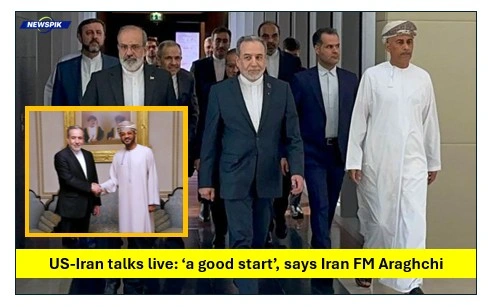

In the world of high-stakes international diplomacy, a “good start,” as it were, can be the best progress for which one dare hope. After months of ever-rising military tension, localized skirmishes and a complete absence of any communication, delegates from the United States and Iran recently held an essential round of indirect talks in Muscat, Oman. Well, neither side signed a hard-and-fast agreement, but if the rhetoric from both sides is to be taken at face value; the Iranians via deputy Foreign Minister Abbas Araghchi especially — we need to start looking into returning this conflict from the battlefield back to negotiating table.
Araghchi describing the talks as a “good start” is more than diplomatic politesse. It represents a mutual acknowledgment that the alternative to such discussions, an all-out regional conflict, is a price neither side is currently prepared to pay. As the world looks on, watching these two antagonists feel their way through a maze of mistrust, the Muscat talks are a fragile bridge over a chasm of historical grievances.
The Muscat Meeting: The Dynamics of the Muscat Session Unplugged
The setting of these talks was as much the point as what they said. Oman has long played the part of a “diplomatic Switzerland” in the Middle East, offering a place where enemies can talk to each other without the intense glare of public focus. The latest round has been indirect: Americans and Iranians remained in separate parts of the Omani palace as local go-betweens regularly shuttled proposals and clarifications between them.
A Focus on the Nuclear File
Central to the talks is a resurrection of an agreement to control Iran’s nuclear programme. The technical terrain has shifted since previous accords fell apart and the strikes last year against what were widely believed to be enrichment plants.
- The Iranian Position: Minister Araghchi said that Iran came to the table “with open eyes and a strong memory.” For Tehran, a “good start” will be an opening salvo that ends in an agreement vindicating its “rights” to nuclear energy for peaceful purposes and – critically – relieving it from the stranglehold of international sanctions.
- The American Side: A half-dozen U.S. officials—led by the Special Envoy Steve Witkoff and including advisers such as Jared Kushner—remained oriented to “containment,” on the other side of the palace. Washington’s ultimate aim is a proof against Iran attaining “breakout capacity” for nuclear weapons, as well as a larger agenda including ballistic missiles and regional stability.
Negotiating Under the Shadow of 2025
To appreciate why such a seemingly modest “good start” is being greeted as such cause for celebration, one has to consider the context of the past year. The bond between Washington and Tehran in 2025 was forged in fire and steel. After a series of regional escalations, the U.S. and Israel carried out targeted strikes on Iranian infrastructure, which Araghchi and other Iranian officials have pointed to as central to their “deep mistrust.”
The “Carrier Diplomacy” Factor
- As the diplomats huddled in Muscat, a shadow player hovered in the wings: The USS Abraham Lincoln aircraft carrier group loitered off the Arabian Sea. This U.S. “dual-track” approach, inviting to the bargaining table while keeping a hand on the holster, puts high pressure on the negotiation and will facilitate making use of the brinkmanship strategy.
- Deterrence vs. Diplomacy: Iran sees the naval presence as “blackmail” to drive them to the table, while Washington sees it as a needed deterrent to see that Tehran stays at the table in good faith.
- Pressures From Within: Both governments are fighting political battles at home. In Tehran, hardliners have been criticizing Araghchi for engaging in any dialogue with “the Great Satan.” In Washington, the administration must also contend with a Congress that is growing more skeptical about Iran’s long-term intentions.
Conclusion: A Turning Point in History
The US-Iran meetings in Oman might be viewed someday as the time when the world pulled back from the precipice. With the shift from “war” to a “good start,” Minister Araghchi and his American counterparts have conceded a basic truth: diplomacy is the only viable path forward. The process is slow, grinding and at times infuriating — but compared with the alternative, the only one that can ever plausibly lead to a future of “sustainable security and stability.”

I am a versatile content writer from the MP region, covering politics, business, crime, current affairs, entertainment, video games, and sports with clear insights, engaging analysis, and timely, reader-focused updates.









