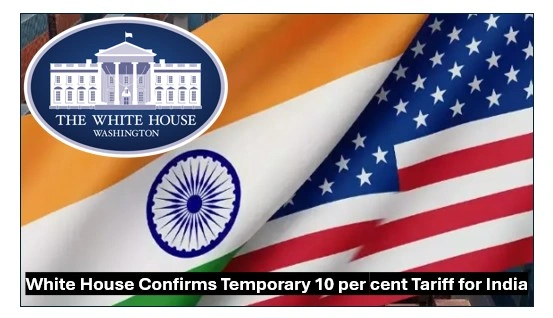

In a head-spinning 48 hours that has roiled the global trading community, a high-stakes game of chess between Washington and New Delhi appears to have taken an unexpected turn. After a pivotal, 6-3 U.S. Supreme Court ruling on February 20, 2026 invalidating President Donald Trump’s all-encompassing “reciprocal” tariff system, the White House is taking an about face: a universal import surcharge of 10%, effective from February 24th, 2026.
This “Plan B” from the Oval Office is a paradox for India. On one hand this is substantially lower than 18% tariff recently agreed however, per the February interim trade deal. On the other, it carries echoes of a period of deep uncertainty as the two largest democracies in the world navigate a relationship that is defined by not just personal chemistry but also cold, hard protectionism.
The 150-Day Clock: A Glimmer of Stability, or a Looming Cliff?
What makes this surcharge temporary is the asterisk that has economists and policy experts here in New Delhi on edge. Unlike the targeted reciprocal tariffs of decades past, Section 122 is nowhere near as pointed a weapon.
- The Expiry Date: These 10 percent tariffs, under Section 122, are set to expire in July 2026 unless Congress extends them.
- The Sectoral Shield: White House, however, has confirmed that “critical” sectors will continue to be exempt—such as pharmaceuticals, critical minerals and certain electronics—to prevent the increased cost of living for American consumers.
- The Legal “Mess”: Justice Brett Kavanaugh, in his dissenting opinion, cautioned that the government may now be on the hook to return billions of dollars (between $130B and $175B) worth of IEEPA tariffs collected earlier. Repayment for Indian companies that have already paid these “illegal” duties will be a long and complicated road.
Though below the 50% rates Indian labor-intensive industries had been facing since Q4-2025, it is two notches above—and a competitive disadvantage in comparison to—the small statutory February 3 rate boost of those receiving and relying on the label.” “Temporary” will preclude any capital investment over the long-term.
Read more: India-US trade deal: White House revises fact sheet
The Human Impact: More Than Just Numbers
Beneath the headlines of “ad valorem duties” are the millions of small entrepreneurs whose livelihoods straddle the trans-Atlantic corridor.
For the MSME (Micro, Small and Medium Enterprises) space in India, falling to 10 per cent is a sigh of relief. A saree exporter who watched their US orders vanish with the repeal of the 50%, feeling their products had become too expensive for American boutique owners, might return to that category of product. But the up-and-down action is contributing to a “wait and see” sentiment.
What Stays the Same?
Even with the new 10% surcharge, eight “legacy” tariffs were not affected by the Supreme Court ruling:
- Section 232: National security-based duties on steel and aluminum are still in place.
- Section 301: Tariffs for unfair trade practices (mostly against China, but also some Indian tech components) will continue.
- The Energy Pivot: India’s pledge to stop buying Russian oil in favor of U.S. crude rests as a linchpin of bilateral faith.
Also read:
- Trump Cuts India Tariffs in Deal He Links to Russian Oil
- Trump Imposes 10% Tariff On Denmark, UK, France For Opposing
Looking Ahead: The July Deadline
Because a 150-day time clock begins to tick on Feb. 24, the pressure falls on the negotiators. For New Delhi, the objective is to transform this temporary 10%”surcharge” into a well-understood rate within a defined Bilateral Trade Agreement (BTA).
For the American consumer, the 10 percent surcharge will probably mean modest price increases on ordinary items, but the administration is betting that a windfall of less expensive Indian energy and tech components will blunt perceptions. The next five months will tell us whether this 10% reduction turns out to be a temporary relief or lays down the foundation for a fresh, if transactional, chapter of Indo-US trade.

I am a versatile content writer from the MP region, covering politics, business, crime, current affairs, entertainment, video games, and sports with clear insights, engaging analysis, and timely, reader-focused updates.